
I get calls all the time where somebody says, “There are bees in my garden — come and take them away.” Quite often they are not honey bees at all. I have been sent photographs of wasps, hornets, carpenter bees and, on rare occasions, insects that were not bees or wasps. Correctly identifying the insect and the type of nest is the first step because the safe response depends on what is actually there. This topic also sits within our broader Bees Around the Home & Garden guide.
TL;DR: Do not identify a nest from one clue alone. Look at the insect’s body shape and hair, where pollen is carried, the number of insects, nest material, entrance traffic and where the nest is located. A temporary honey bee swarm is different from an established honey bee colony, and both are different again from bumble bee, carpenter bee and social wasp nests. If the insects cannot be identified safely from a distance, send clear photos or video to someone experienced rather than disturbing the nest. If the activity is coming from soil, compare it with our guide to bee nests in the ground.
If you are learning the basics of honey bee behaviour and hive management, our Beginner Beekeeping guide provides useful background.
Identifying a Bee’s Nest Starts With the Insect
There are many creatures out there that a jumpy person may mistake for bees. For a beekeeper, the useful question is not simply “Where is the nest?” but “What insect is using that nest?”
You will find there are times of year when the phone calls arrive in waves. They often begin something like: “Hi, you don’t know me, but somebody said you can help me with bees. They have been here for months and I am scared my child, wife, husband, dog or cat will get stung…”
At this point the caller is often ready to tell you their entire life history. I normally interrupt politely and say something along the lines of: “Great — you have some sort of insect there. Let us work out what it is first.”
How to Identify a Bee or Wasp Nest Over the Phone
A good photo or short video can solve a surprising number of these calls without anybody walking up to an unknown nest.
First Questions to Ask
- Where exactly are the insects?
- How long have they been there?
- Are they clustered in the open or disappearing into a hole?
- Can you send a clear photograph of an individual insect?
- Can you send a short video showing insects entering and leaving?
I usually prefer video because movement and traffic patterns tell you things a single blurry photograph cannot.
Second-Round Questions
- Are the insects hairy or mostly smooth and shiny?
- Can you see obvious pollen loads on the hind legs or elsewhere on the body?
- Are dozens or hundreds using the same entrance?
- Is the entrance in soil, wood, a wall, roof, tree cavity or other structure?
- Can you see paper nest material, wax comb or exposed honeycomb?
- Is the object containing the nest removable, such as a log or unused box?
These clues often narrow the possibilities to honey bees, bumble bees, carpenter bees, another solitary bee, yellowjackets, hornets or paper wasps.
Do Not Use Pollen as the Only Identification Test
Visible pollen is useful, but the simple rule “pollen on legs means bee; no pollen means wasp” is too crude.
Honey bee and bumble bee females commonly carry obvious pollen loads on the hind legs. Many solitary bees carry pollen in different places, including dense hairs on the underside of the abdomen. Male bees do not collect pollen at all. Wasps can also visit flowers, although they lack the specialised pollen-carrying structures seen in many bees.
So I use pollen as one clue among several. Body hair, waist shape, nesting material, nest entrance, colony size and behaviour matter just as much.
A Practical Identification Guide
| What you see | Likely insect | Useful next step |
|---|---|---|
| Many small, hairy bees using one cavity; some workers carrying pollen | Honey bees | Confirm from a clear photo, then assess whether it is a swarm moving in or an established colony. |
| Large fuzzy bees using an underground or concealed cavity | Bumble bees | Compare with our honey bee vs bumble bee guide. |
| One or a few large bees repeatedly entering round holes in bare wood | Carpenter bees | Look for the characteristic wood-boring entrance and shiny abdomen. |
| One or a few bees using individual small holes or stems | Solitary bees | Usually leave them alone unless the nesting location creates a genuine problem. |
| Smooth-bodied yellow/black or dark wasps using one busy ground or wall entrance | Yellowjackets or another social wasp | Keep your distance and identify the species before attempting control. |
| Open paper comb under an eave or structure | Paper wasps | Avoid disturbing the nest and use species-appropriate management if removal is necessary. |
If you are dealing with bumble bees, see our guide to moving or managing bumble bees without killing them. If you suspect yellowjackets around a beehive, our article on yellowjackets and honey bees covers that interaction.
Site Inspection: Identify Before You Disturb
I used to approach many removal jobs with a smoker and bee suit ready. The important point is that you do not need to smoke an unknown nest merely to identify it. Start from a safe distance and use your eyes, camera zoom or binoculars if necessary.
A smoker is a tool for working honey bee colonies. It should not be treated as a universal method for calming unidentified wasps or hornets.
Protective bee clothing can reduce sting exposure, but it is not magic armour. Wasps and hornets can find gaps, and some can sting through material that is thin or pulled tightly against the skin. If you do not know what you are dealing with, identification from a distance is safer than testing your suit.
Bee Nest vs Wasp Nest: What to Look For
Honey bees are hairy, brown-to-golden insects with relatively broad waists. Their colonies build vertical sheets of wax comb containing brood, pollen and honey, usually inside a sheltered cavity.
Many social wasps are smoother-bodied and have more strongly narrowed waists. Yellowjackets and hornets make paper nests from chewed plant fibres rather than beeswax.
There are exceptions and mimics, so nest material and insect appearance should be considered together. If you can capture a clear image without approaching the nest, that is much more useful than guessing from colour alone.
Great Black Wasps and Other Solitary Wasps
Wasps such as the great black wasp are solitary digger wasps rather than yellowjackets or hornets. They hunt prey for their nests and are not defending a large social colony in the same way a yellowjacket nest does.
I have always treated large solitary wasps with respect. A sting is still a sting, even if the insect is not interested in attacking you unless handled or trapped.
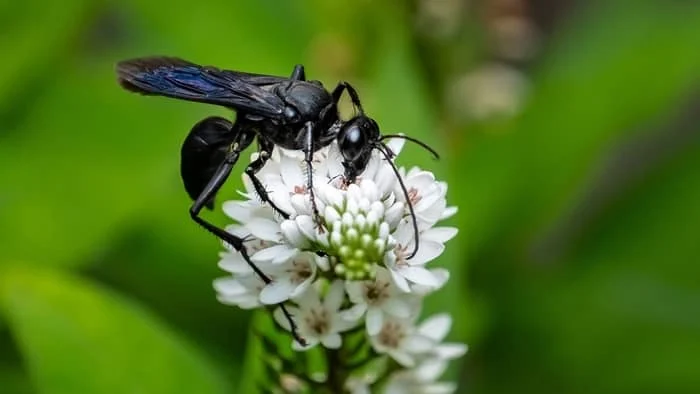
A great black wasp. Large solitary wasps can look alarming, but identifying the species and nesting behaviour matters before deciding what to do.
Spider Wasps
Special mention goes to spider wasps. These insects hunt spiders, sometimes very large ones. I have been stung by spider wasps a number of times and each time the pain was extraordinary. Rolling around on the ground and acting like a fool was about the level of intellectual activity available to me for a little while.
Some spider-wasp stings rank among the most painful insect stings recorded on the Schmidt sting pain index. That scale describes pain, not the medical severity of an allergic reaction or toxin exposure, so it should not be used as a simple danger ranking.
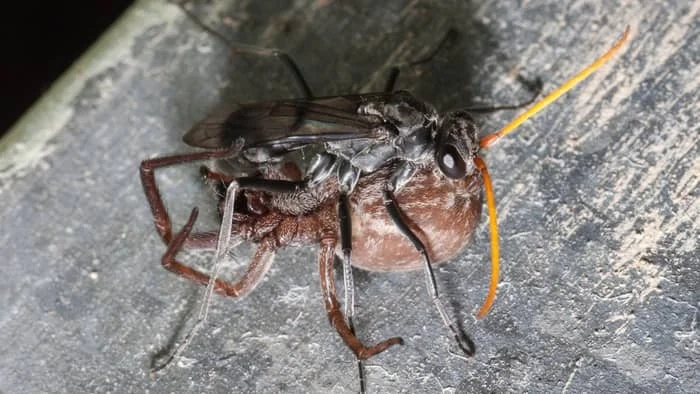
Spider wasps hunt spiders and can deliver extremely painful stings if handled or trapped.
If you have identified a wasp nest but cannot confidently identify the species or safely reach the nest, call an experienced pest-management professional. Bees are for beekeepers; unknown wasps are not a good place to improvise.
Different Types of Honey Bee Nests
Once you know the insects really are honey bees, the next step is to distinguish a temporary swarm from an established colony.
A Temporary Swarm Cluster
A swarm is a large group of honey bees travelling with a queen while scout bees search for a permanent nest site. The bees often form a dense cluster on a branch, fence, wall or other object for a few hours or days.
A swarm cluster is not the same thing as a built nest. If there is no comb and the cluster is simply hanging temporarily, a beekeeper can often collect it relatively easily.
An Established Cavity Colony
Honey bees strongly prefer cavities such as hollow trees, wall voids, soffits, chimneys and other sheltered spaces. Once they move in and begin building comb, storing honey and raising brood, removal becomes a much larger job.
Bees find some bizarre places to make nests. Every time I write about this I remember another strange removal from the past three decades. High on my list are colonies inside a whale skull in front of a museum and inside an elephant skull at a game reserve. Honey bees are very good at finding cavities that nobody else thought of as real estate. If the nest is in a wall cavity, see our guide to bees nesting in wall cavities.
For colonies in structures, see our guide to removing a honey bee nest without killing the bees.
An Exposed-Comb Colony
Honey bees occasionally begin building comb in the open on a branch, under an overhang or against another exposed surface. These are established exposed-comb colonies, not merely “tree swarms.”
Exposed colonies often struggle with weather, predators and robbing in colder climates, although they can persist much longer in warm regions. I have personally seen exposed colonies survive remarkably cold conditions where the bees heavily propolised the nest, but that is an observation rather than something to expect from every exposed colony.
When to Call a Professional
Get experienced help if insects are nesting inside a wall or roof, access requires ladders or structural work, a large colony is defensive, the species is uncertain, people are being stung, or anyone nearby has a serious sting allergy.
For an established honey bee colony in a building, killing the adult bees does not remove comb, brood or honey. Proper removal matters because abandoned hive material can create odour, leakage and pest problems inside the structure.
For wasps or hornets, use a pest-management professional who can identify the species and choose an appropriate control method. Different insects require different treatment, which is the whole reason correct identification comes first.
The Bottom Line
Identifying a bee’s nest is really an exercise in slowing down before doing anything dramatic. Get a clear look at the insect, work out whether you have a solitary bee, bumble bee, honey bee, wasp or hornet, and then decide whether what you are seeing is a temporary cluster or an established nest.
Pollen is a useful clue, but it is not enough on its own. Photos, video, nest material, entrance traffic, body shape and behaviour together give you a much more reliable answer.
Bee and Wasp Nest Identification FAQs
How can I tell whether I have bees or wasps?
Use several clues rather than one. Honey bees and bumble bees are generally hairier and may carry obvious pollen loads, while many social wasps are smoother-bodied with a narrower waist. Nest material, entrance traffic, body shape, behaviour and clear photographs are often more reliable together than pollen alone.
Does pollen on the legs prove an insect is a bee?
No. Visible pollen is a strong clue for a foraging female bee, especially a honey bee or bumble bee, but not every bee carries pollen on the hind legs and male bees do not collect pollen. Some solitary bees carry pollen on the underside of the abdomen instead.
What is the difference between a honey bee swarm and an established nest?
A swarm is a temporary cluster of bees travelling with a queen while scouts search for a nest site. An established colony has occupied a cavity or exposed site and begun building comb, storing food and raising brood.
How can I identify a bee nest from a photo or video?
Ask for clear close-up images taken from a safe distance showing the insects, the entrance or nest, and the surrounding structure. Video of insects entering and leaving can also reveal traffic patterns and whether they are using a cavity.
Should I use smoke on an unidentified nest?
No. Do not approach or smoke an unknown stinging-insect nest simply to identify it. First identify the insects from a safe distance. A beekeeper’s smoker is useful for managed honey bees, but it is not a general-purpose tool for wasps, hornets or an unknown colony.
Do bee suits protect against wasp and hornet stings?
Protective clothing can reduce exposure, but no suit should be treated as sting-proof against every species. Wasps and hornets can exploit gaps, and some can sting through thin or tight material. Unknown nests are better assessed from a safe distance.
Where do honey bees usually build nests?
Honey bees strongly favour enclosed cavities such as hollow trees, wall voids, soffits and similar spaces. They can occasionally build exposed comb on branches or structures, especially where winters are mild.
When should I call a professional?
Call an experienced beekeeper, bee-removal professional or pest-management professional if the insects are in a wall or roof, the nest is difficult to access, there is a large colony or swarm, the species is uncertain, people are being stung, or anyone nearby has a serious sting allergy.

Dr Garth A. Cambray is a beekeeper, biotechnologist and researcher with nearly three decades of practical beekeeping experience. He holds a PhD in Biotechnology from Rhodes University and has worked extensively in honey production, fermentation biotechnology and value-added bee products. View Dr. Garth Cambray’s credentials, research and experience.
Ready to Start Beekeeping?
Take the next step with our free beginner beekeeping guide. Learn what equipment you need, how to set up your first hive and what to expect during your first season.
You Might Also Like:
 What Temperature Do Wasps Stop Flying? [All you need to know]
 Do Wasps Produce Honey? A Story With A Sting In The Tail!
 The Ultimate Guide to Identifying Californian Native Super Bees
 Killing Bees With Soapy Water: When Is It Appropriate?
 How to Get Bees Out of Your House
 Do Yellow Jackets Kill Honey Bees?