How long does it take bees to make a hive? There is no single answer. A strong swarm or nuc in excellent weather with abundant nectar, pollen and a productive queen can draw a surprising amount of comb in a few weeks. A weaker colony in poor forage may take much of a season to become fully established.
TL;DR: Think in terms of weeks to months, not a fixed number of days. Under exceptional conditions I have seen bees draw two brood boxes in about six weeks. Under more ordinary conditions, eight weeks or longer is a more realistic expectation for substantial build-out, and some colonies may need most of their first season. Starting population, queen performance, nectar or syrup, pollen, temperature and available comb all matter.
If you are setting up your first colony, the Beginner Beekeeping guide gives the wider context for feeding, inspections and adding equipment.
How Long Does It Take Bees to Make a Hive?
As an experienced beekeeper, I often have people ask me this question. I like to answer it with a human comparison. How long does it take people to build a city? London has grown for centuries; some modern cities expanded dramatically in a few decades. The rate depends on population, resources and conditions.
A bee colony works the same way. “Making a hive” can mean several different things: drawing wax comb, establishing a brood nest, building a large worker population, or filling boxes with stored honey. Those stages do not all happen at the same speed.
The main factors are:
- the number of bees you start with;
- queen performance;
- nectar or supplemental syrup;
- pollen and overall nutrition;
- temperature and weather;
- whether the colony starts with drawn comb or bare foundation; and
- the quality and suitability of the hive equipment.
Number of Bees and Queen Quality
If a swarm starts with a large workforce, it has more bees available to forage, secrete wax, care for brood and regulate the nest. A small swarm has to perform the same jobs with fewer workers, so expansion is naturally slower.
Queen performance matters too. Penn State notes that a healthy, fertile queen can lay more than 2,000 eggs per day during peak season. That does not mean every queen should be judged against one fixed daily number; laying rate changes with season, nutrition, genetics, colony population and available comb.

Nectar Flow or Sugar Source
Wax is expensive for bees to produce. A strong nectar flow gives the colony the carbohydrate energy needed for comb construction. When natural nectar is limited, feeding sugar syrup can help a newly established colony keep drawing comb.
Mississippi State University Extension recommends supplemental syrup for new colonies because incoming sugar supports wax production and colony growth. The key is to feed for a reason, not simply pour syrup into a hive indefinitely. If bees stop taking it during a strong natural flow, or if the brood nest becomes syrup-bound, management needs to change.
Pollen and Brood Rearing
Pollen supplies protein, lipids, vitamins and minerals needed to rear brood. Wax production is driven largely by carbohydrate intake, while pollen is critical because it allows the colony to rear the young bees that become the next workforce.
If natural pollen is poor, a suitable pollen substitute can support brood rearing. A colony with good nectar and pollen flows can expand far faster than one short of either resource.
Hive Position and Temperature
Weather strongly affects colony growth. Cold, wet or windy conditions reduce foraging time and force more bees to stay home regulating brood temperature. Warm, settled weather with good forage gives the colony more working hours.
I would not try to define one perfect hive location from temperature alone. Morning sun, summer shade, wind protection, drainage and local climate all matter.
Hive Equipment and Available Comb
A sound hive body helps because the colony is not wasting effort dealing with major gaps, leaks or poor-fitting equipment. Drawn comb also gives a new colony an enormous head start because the queen can lay and workers can store food immediately.
If you are buying new equipment, this Mann Lake Langstroth hive box is one example. Mann Lake sells 8-frame and 10-frame deep Langstroth hive boxes, although availability of individual marketplace listings can change.
Gaps and poor-fitting components can also make it easier for yellow jackets and other wasps or small hive beetles to exploit a weak colony.

How Fast Can Bees Build Two Brood Boxes?
Under optimal conditions — a large starting population, strong queen, abundant nectar and pollen, good weather and suitable equipment — bees can draw comb very quickly.
I have seen colonies move into an empty hive and draw the comb in the first brood box and a second brood box in about six weeks. That was during an exceptionally strong nectar and pollen flow. I still regard that as a best-case observation, not a promise.
Mississippi State University Extension gives a useful comparison: a newly installed nuc doing extremely well may draw two to three boxes of foundation during its first two months. That supports the idea that rapid build-out is possible, while still making clear that this is strong performance rather than an average timetable.
Under moderately good conditions, I would allow roughly eight weeks or more for a strong new colony to build substantial comb and occupy two deep boxes. A package starting with no comb has an even harder job than a nuc because it must build its entire nest from scratch.
As the colony expands, use the condition of the actual hive rather than a calendar to decide when to add a second brood box.
How Long Does It Take Bees to Make Honeycomb?
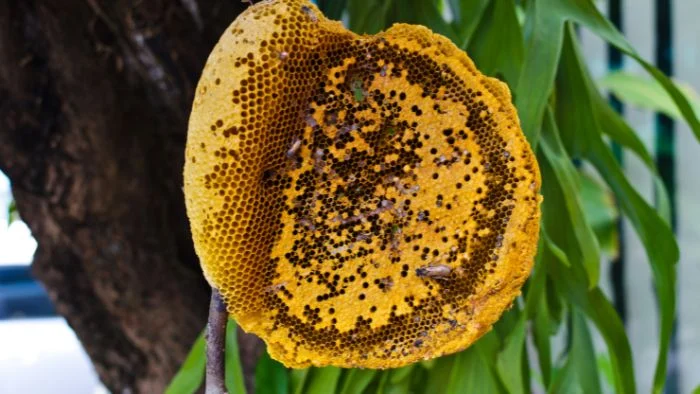
Bees do not wait until the colony is “finished” before making honeycomb. They build worker comb for brood and food storage as soon as conditions allow.
Comb construction accelerates when food intake is high. Mississippi State notes that a new colony supplied with syrup can draw several new deep frames while feeding is maintained, and that building ten deep combs from foundation represents a substantial energy investment.
In a booming colony during a major flow, comb can appear remarkably quickly; in poor conditions, very little may be built at all. There is too much variation to use a general “pounds of honeycomb per day” figure as a reliable benchmark.
How Big Can a Beehive Get?
A strong honey bee colony can contain tens of thousands of workers at its seasonal peak. The exact population varies with genetics, queen performance, brood area, season, forage and worker mortality.
A queen can lay more than 2,000 eggs per day at peak performance, but colony population is also limited by brood-rearing capacity, food, space, worker lifespan and seasonal conditions. There is therefore no useful fixed maximum population for European or African honey bees, and adding a second queen does not translate into a simple doubling of colony size.
Trying to build the “world’s biggest” hive is more of an ego exercise than a practical beekeeping objective. Very large colonies can be productive, but they are also heavier, harder to inspect and more difficult to manage for swarming.
The Monster Hive I Removed
I once removed a wild hive in a garden shed and it spanned nearly six feet down the wall, four to five feet deep and about seven feet long. I found what appeared to be multiple brood nests, and my interpretation at the time was that several colonies may somehow have grown together.
I removed around 200 lb of honey and roughly half that mass in brood comb. The hive was a monster. That is a field observation from one unusual removal, not a model for how large a normal managed colony should become.
How Can You Help a New Hive Grow Faster?
You can influence colony growth, but you cannot command it. My old reserve-bank analogy still works rather well: a beekeeper can inject “liquidity” by providing food at the right time, but the economy still needs workers, resources and somewhere productive to put the investment.
For a new colony:
- start with a healthy queen and adequate population;
- feed syrup when natural nectar is inadequate and comb must be drawn;
- ensure pollen or suitable substitute is available for brood rearing;
- use sound equipment with enough space for expansion;
- avoid repeatedly disturbing the colony while it is building;
- add the next box when the colony is actually ready for it; and
- time growth so the workforce is strong when the main nectar flow arrives.
If you know a major flowering event is coming, building the colony beforehand can put more foragers in the field when the nectar arrives. More bees can mean a larger crop — but only if the forage is there for them to collect.
So, How Long Does It Take Bees to Make a Hive?
A very strong colony can make extraordinary progress in six to eight weeks. Many colonies will take longer, and some need most of their first season to become fully established.
The useful answer is not one magic number. Watch the colony. If the queen is laying well, brood is expanding, food is coming in and new comb is being drawn, the hive is progressing. Your job is to remove unnecessary bottlenecks and let the bees do what they are exceptionally good at doing.
FAQs
How long does it take bees to build a hive?
There is no single timetable. Under very strong conditions a large swarm or nuc can draw substantial comb within several weeks, but many new colonies need much of their first season to build comb, rear enough workers and store food.
How long does it take bees to draw a brood box?
It depends on colony strength, nectar or syrup intake, pollen availability, temperature and whether the bees start with foundation or drawn comb. Strong colonies during a good flow can draw frames quickly, while weak colonies may take many weeks.
Does feeding sugar syrup help bees build comb faster?
It can. Extension guidance for new colonies recommends supplemental syrup because incoming carbohydrate supports wax production and colony growth, especially when natural nectar is limited.
Do bees need pollen to build comb?
Wax production is powered mainly by carbohydrate, but pollen is essential for brood rearing because it supplies protein, lipids and other nutrients. A growing colony needs both energy and good nutrition to expand its workforce.
How quickly can a new colony fill two deep boxes?
A very strong colony can sometimes do this in roughly six to eight weeks under excellent conditions. That is a best-case outcome, not a reliable deadline. Weather, forage, queen performance and starting colony size can make the process much slower.
How many eggs can a queen bee lay per day?
A healthy productive queen can exceed 2,000 eggs per day during peak season. Actual laying rate varies with genetics, colony population, nutrition, season and available comb.
When should I add a second brood box?
Add space when the first brood box is substantially occupied and the colony is actively expanding. Do not add empty volume simply according to a calendar; colony strength and drawn comb matter.
Can a beehive get too big?
Strong colonies can become very populous, but bigger is not always easier to manage. Very large colonies can be heavy, defensive, prone to swarming and awkward to inspect, so practical hive size matters more than chasing a maximum population.

Dr Garth A. Cambray is a beekeeper, biotechnologist and researcher with nearly three decades of practical beekeeping experience. He holds a PhD in Biotechnology from Rhodes University and has worked extensively in honey production, fermentation biotechnology and value-added bee products. View Dr. Garth Cambray’s credentials, research and experience.
Ready to Start Beekeeping?
Take the next step with our free beginner beekeeping guide. Learn what equipment you need, how to set up your first hive and what to expect during your first season.