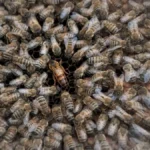
You can split a strong beehive without finding or adding a queen. The simplest version is a walk-away split: divide the bees, brood and stores between two boxes, make sure both halves contain eggs or very young worker larvae, and let the queenless half raise an emergency queen. Splitting and queen replacement sit within the wider Queen Bees & Swarming guide.
TL;DR: Split only a strong colony. Give both halves brood, food and plenty of bees, with eggs or very young larvae in each half. One side will retain the original queen; the other should build emergency queen cells. Expect the new queen to take roughly three to four weeks from the split before she is likely to be laying, sometimes longer if weather delays mating.
If you are still learning the basics of colony management, the Beginner Beekeeping guide provides useful context before attempting your first split.
When Would You Split a Hive Without Adding a Queen?
We have covered the broader reasons for splitting a hive to prevent swarming. Normally, if I know I am going to make splits, I prefer to have good queen cells ready or mated queens available. That shortens the brood break and gives you more control over what happens next.
But things go wrong. Queen cells fail. Ordered queens are delayed. Sometimes you simply have a strong colony, enough equipment and the need to make a split now. In that situation, allowing the queenless half to rear its own queen is a perfectly legitimate method.
How to Split a Beehive Without Finding the Queen
There are complicated ways to do this. I believe in life, complexity invites failure. Hence simple methods work well.
I have used this basic method to make many splits over the years with a high level of success. The important part is not dividing every frame with mathematical perfection. It is making sure each new colony has enough bees, food and brood to function, and that the queenless half has suitably young brood from which to raise a queen.
1. Start With a Strong Colony
Do not split a weak hive. A new division needs enough nurse bees to care for brood, enough workers to defend the entrance, adequate honey and pollen, and enough population to continue functioning while one half goes through a brood break.
Choose a colony that is strong enough to lose a substantial part of its population without leaving either half marginal. Our guide to how many splits can be made from one hive helps put realistic limits around that decision.
2. Set Up the Two Hive Bodies
Go to the hive and smoke it gently. Move the original hive a short distance to one side and place the new box beside it. If you are using full brood boxes, have enough compatible drawn comb or frames ready to fill unused space.
3. Divide Brood, Bees and Stores
Move roughly half of the brood frames and food resources into the daughter hive, keeping brood together rather than scattering it through the box. Try to give both halves a useful mix of capped brood, open brood, pollen and honey.
You do not need to know which half contains the queen for this method to work.

4. Make Sure Both Halves Have Very Young Brood
Both colonies should contain eggs or very young worker larvae. Bees do not turn an egg directly into a queen cell; after the egg hatches, workers can select a young female larva and feed it as a queen.
Giving both halves brood at the youngest stages ensures the queenless colony has suitable material to raise an emergency queen. Our guide to queen cell stages shows what to look for as the process develops. If you want more control over replacement queens, see our guide to raising honey bee queens.
5. Deal With Returning Foragers
If you put both boxes beside one another, older flying bees tend to return to the location they remember. That can make one side stronger than the other.
One simple option is to move one split to another apiary. Extension guidance commonly uses an off-site location of roughly 3 miles or more to reduce drift back to the parent location. My own method has often been to move one box well away and leave the other at the original site.
If moving the split off-site is not practical, you can keep both colonies in the same yard, but you need to watch population balance. Entrance orientation, temporary grass or other reorientation cues, and adding extra nurse bees can help. The important thing is that neither half is left too weak.
What Happens After the Split?
Inspect for Queen Cells
About a week after the split, inspect both colonies. The queenright half should normally have eggs from the existing queen. The queenless half should have emergency queen cells. Later, use the signs of a queen-right hive to confirm the new queen has established properly.

Do not assume that a queen cell means the job is finished. Queen development, emergence, maturation, mating flights and the start of egg laying all take time.
A queen takes about 16 days to develop from the egg stage. Because the emergency colony may start with a larva that is already a day or two old, queen emergence can occur roughly 8–12 days after the split. She then needs time to mature, fly, mate and begin laying.
As a practical guide, first eggs from a colony-raised queen are often expected around 24–28 days after the split. Poor weather or limited drone availability can push this later. That brood break is one of the main costs of making a walk-away split.
Do Not Keep Opening the Queenless Half
Once you have confirmed good queen cells, give the colony some peace. Repeatedly opening and disturbing a small queenless split increases the chance of damaging a cell or interfering with the process.
When the expected mating period has passed, inspect carefully for eggs and young larvae rather than repeatedly hunting for the virgin queen.
Is This the Best Way to Split a Hive?
At face value, usually not. If you add a good ripe queen cell or a mated queen, the split can recover more quickly because the brood break is shorter.
But “best” depends on what you are trying to achieve. A walk-away split is simple, does not require finding the queen, and does not depend on a purchased queen arriving on time. It also allows the new queen to mate naturally with drones in the surrounding population.
Genetic Diversity Matters — But It Is More Complicated Than It Looks
Honey bees have an unusual mating system. A queen normally mates with multiple drones, often from colonies across the surrounding area. That multiple mating increases genetic diversity among the workers inside a colony.
Genetic diversity matters because very narrow breeding populations can create problems. In honey bees, inbreeding can increase the production of diploid drones because of their complementary sex-determination system, reducing brood viability. Diversity also gives populations more genetic variation on which natural selection and selective breeding can act.
That does not mean commercial queens are automatically low-diversity or that queens from one breeder are all close sisters. Good breeders actively manage queen lines, drone sources and mating to preserve useful diversity while selecting for desirable traits.
The practical lesson is simpler: avoid building an entire apiary around an unnecessarily narrow genetic base. Diversity is strength, but selection matters too.
What Happens When a Split Raises Its Own Queen?
When the queenless half raises a daughter queen, she leaves the hive after emergence and mates with drones in drone congregation areas. Honey bee queens mate with multiple drones, which gives the resulting worker population a mix of paternal lines.
I used to explain this as the queen flying fast until only the strongest drones could catch her. There is some evidence that mating flights impose selection on drone flight ability and developmental quality, but it is not accurate to say the queen deliberately exhausts the drones and then chooses only the fastest or strongest males.
Natural mating is a large, somewhat untidy genetic mixing system. That is part of its value.
Will Repeated Walk-Away Splits Create Locally Adapted Bees?
They can contribute to local adaptation, but they do not guarantee it. Open-mated queens pick up genes from the surrounding drone population, not just from your own apiary. If locally successful colonies contribute many drones, their genetics may become more common, but genes also flow in from elsewhere.
Natural selection can favour traits that work well under local conditions. Selective breeding can do the same thing more deliberately. The strongest approach is often to keep locally successful colonies, maintain genetic diversity and occasionally introduce useful new stock rather than assuming that either complete isolation or constant replacement is ideal.
My South African Experience With Varroa
I have worked with bees in different parts of the world, and my experience with Apis mellifera capensis, the Cape honey bee, is one reason I take population genetics seriously.
Varroa was detected in South Africa in the late 1990s. When mites spread through the Cape honey bee population, there was an initial period of damage. In my own apiaries I saw chalkbrood, reduced drone numbers, deformed wings and colony losses.
Over the following years, the picture changed dramatically. Research now supports the broader observation that both A. m. capensis and A. m. scutellata populations in South Africa developed population-level resistance or tolerance to Varroa without the widespread treatment regime used in many other countries.
That does not mean genetic diversity alone caused the change. Studies point to a combination of natural selection, existing resistance traits, colony biology, wild bee populations, mite reproduction, hygienic behaviour, grooming, brood-development timing and virus interactions. The South African experience is therefore a powerful example of evolution in action, but not a one-factor story.
What I observed in my own hives fits into that larger population story: Varroa went from an obvious new problem to something that became much harder to find at damaging levels.
Advantages and Disadvantages of a Queenless Split
| Advantages | Disadvantages |
|---|---|
| You do not need to find the queen | The queenless half has a substantial brood break |
| No purchased queen is required | Queen cells, mating flights or the new queen can fail |
| Simple equipment and procedure | Weather can delay mating |
| Allows open mating with the local drone population | You have less control over the genetics of the new queen |
| Useful when purchased queens or ripe cells are unavailable | Weak colonies may not recover well enough to justify the split |
In Summary
A strong hive can be split without finding or adding a queen. Divide the bees, brood and stores sensibly, give both halves eggs or very young larvae, manage returning foragers, and let the queenless half raise an emergency queen.
The method is slower than adding a mated queen or ripe queen cell, but it is simple and useful. It also gives the new queen access to the surrounding drone population, which can contribute to genetic diversity.
Just do not confuse open mating with guaranteed local adaptation. Genetics, selection, environment and management all interact. Bees are complicated animals, which is precisely why I like keeping the method simple and the conclusions cautious.
If you are waiting for the queenless half to recover, read how long a hive can be queenless for the warning signs and timing to watch.
Frequently Asked Questions
Can you split a beehive without finding the queen?
Yes. A strong colony can be divided without locating the queen if both halves receive enough bees, food, brood and eggs or very young worker larvae. The queenless half can then raise an emergency queen.
How long does a queenless split take to make a new queen?
Queen cells are usually visible within several days. A queen develops about 16 days from the egg stage, then needs time to mature, mate and begin laying. In a walk-away split, first eggs from the new queen are often expected roughly 24 to 28 days after the split, although weather and mating conditions can extend that.
Does each half of the split need eggs?
Each half should contain brood of suitable age, ideally including eggs and very young worker larvae. Bees raise emergency queens from young female larvae, so providing young brood gives the queenless half suitable material to work with.
How far should I move a split?
Moving one split to an off-site location about 3 miles or more away is a reliable way to reduce older foragers drifting back to the original hive. Splits can also be kept in the same apiary, but bee distribution and entrance placement then need more attention.
Is a walk-away split better than adding a purchased queen?
Not automatically. A purchased mated queen or ripe queen cell usually reduces the brood break and gives more control over genetics. Letting a colony raise its own queen is slower but can be useful when queens are unavailable or when you deliberately want open mating with the surrounding drone population.
Does letting bees raise their own queen improve genetic diversity?
It can increase genetic mixing when the new queen mates naturally with multiple drones from the surrounding population, but it does not guarantee better genetics or local adaptation. The result depends on the diversity and quality of the drone population and the colonies contributing genes to the area.

Dr Garth A. Cambray is a beekeeper, biotechnologist and researcher with nearly three decades of practical beekeeping experience. He holds a PhD in Biotechnology from Rhodes University and has worked extensively in honey production, fermentation biotechnology and value-added bee products. View Dr. Garth Cambray’s credentials, research and experience.
Ready to Start Beekeeping?
Take the next step with our free beginner beekeeping guide. Learn what equipment you need, how to set up your first hive and what to expect during your first season.