What is the difference between raw honey and pure honey? The simplest answer is that raw describes processing, while pure describes ingredients. Raw honey is generally sold with minimal heating and processing. Pure honey means the jar contains honey without another sweetener or ingredient added. A honey can be both raw and pure.
TL;DR: “Pure honey” tells you the product is honey rather than a blend with another sweetener. “Raw honey” tells you something about how the honey was handled after harvest, but the term is not one universal legal grade everywhere. “Filtered,” “unfiltered,” “organic,” “comb honey” and “honeydew honey” all describe different things again.
What Is Honey?
Honey is a concentrated natural sugar solution produced by honey bees. Bees collect nectar from plants, or in some cases plant secretions and the excretions of plant-sucking insects, then transform that material with their own enzymes, reduce the moisture content and store it in comb.
The main sugars are fructose and glucose, with smaller amounts of sucrose and other sugars. Honey also contains water, organic acids, enzymes, minerals, proteins, aroma compounds and particles associated with its floral or plant origin. The amount of pollen in honey varies with the source and the way the honey is processed.
Raw Honey vs Pure Honey
| Term | What it usually means | What it does not tell you |
|---|---|---|
| Raw honey | Honey sold with minimal heating and processing | It does not automatically prove floral source, organic status or absence of all straining |
| Pure honey | Single-ingredient honey with no added sweetener or other ingredient | It does not tell you whether the honey was heated, filtered or crystallized |
| Filtered honey | Honey that has had small particles removed to some degree | It does not automatically mean the honey was pasteurized |
| Organic honey | Honey produced and certified under an applicable organic standard | It is not simply another word for raw or pure |
In the United States, FDA guidance uses “pure” to distinguish single-ingredient honey from products containing other sweeteners or ingredients. A jar containing honey plus corn syrup, sugar or flavouring should not simply be labelled as honey.
“Raw” is less tidy. There is no single globally consistent legal definition that makes every jar labelled raw directly comparable. In practice, raw honey generally means honey that has not been heavily heated or processed after it leaves the hive.
Honeydew Honey Is Still Honey
This is one of those areas where terminology causes unnecessary confusion. Honey does not have to originate directly from flower nectar.
Codex defines honey as a substance produced by honey bees from flower nectar, plant secretions, or excretions of plant-sucking insects on living parts of plants. Honeydew honey is therefore a recognised type of honey.
In places such as forested regions of Europe, bees can collect sugary honeydew produced by sap-feeding insects. The resulting honey can be darker, stronger-flavoured and compositionally different from blossom honey.
Bees can also collect other accessible sugar-rich liquids, but that does not mean every sweet liquid stored by bees automatically qualifies as honey under food standards. Feeding colonies sugar syrup during a honey flow can also create serious authenticity and labelling problems if that syrup ends up in harvested stores.
Comb Honey
Comb honey is honey sold while it is still sealed in the beeswax cells in which the bees stored it. Codex recognises comb honey as a legitimate presentation of honey.
I have worked in beekeeping operations in Africa where a large proportion of the crop was sold as cut comb. I like comb honey because the consumer sees the wax structure exactly as it came from the hive, but it still depends on good apiary management and careful control of anything that may accumulate in wax.
Organic status is a separate matter. A comb honey is not automatically organic, and organic honey is not limited to one region of the world. Organic certification depends on the applicable production standard, certifier and audit requirements.
Extracted Honey
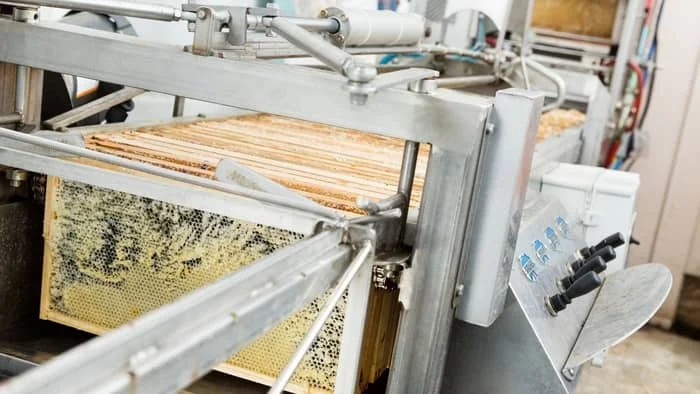
Most commercial honey is extracted from comb using a centrifugal extractor. Once the caps are removed from ripe honeycomb, the frames are spun and the honey is collected for settling, straining, filtering or bottling.
Strained or Coarsely Filtered Honey
This is what many small beekeepers do. Honey passes through a coarse strainer to remove large pieces of wax, bits of propolis and the occasional bee part. I once found a bolt from my extractor in the strainer. That was also the moment I discovered why the extractor had stopped working.
After settling, wax floats to the top and heavier debris sinks. The clear middle portion can then be bottled. This sort of honey may still contain pollen and very fine particles.
Finely Filtered Honey
Fine filtration removes smaller particles and can produce a clearer-looking product. In some commercial systems the honey is warmed because lower-viscosity honey moves through filters more easily.
Heating and filtering are separate processing choices. Filtered honey is not automatically pasteurized, although large-scale processing may combine warming, flash heating and filtration.
Crystallization is also normal. Some honey crystallizes quickly because of its natural glucose-to-water balance; other honey stays liquid for a long time. Crystals do not mean the honey has spoiled.
What About Very Heavily Processed Honey?
Honey processors have a range of technologies available for concentrating, filtering and standardising honey. The important distinction is whether the finished food still meets the legal standard for honey in the market where it is sold.
Codex and current European rules limit processing that materially damages honey’s essential composition or removes constituents such as pollen beyond what is necessary to remove foreign matter. That is a more useful boundary than simply dividing jars into “natural” and “unnatural.”
Raw Honey vs Regular Honey
For me, the attraction of minimally processed honey is simple: I like honey that still tastes strongly of where the bees worked. I normally eat my own honey or honey from beekeepers I know. I also swap honey with other beekeepers, much as wine and mead makers swap bottles. It gets boring eating too much of your own honey, and different floral sources are part of the fun.
That does not mean supermarket honey is automatically fake or useless. Properly labelled commercial honey can still be genuine honey. The questions are how much it has been heated, how finely it has been filtered, where it came from and whether anything has been added.
If you are interested in heating specifically, see what happens when raw honey is heated.
How to Make Sure Your Honey Is Real
The first thing to do is read the label. In the United States, FDA guidance says a food containing only honey can simply be labelled “honey.” A blend of honey and another sweetener should be labelled as a blend and list the ingredients.
Honey fraud is real. FDA testing in 2025 found undeclared added sweeteners in a small number of sampled products, which is exactly why clear labelling and supply-chain traceability matter.
Buying directly from a beekeeper is useful because you can ask practical questions: What flowers were the bees working? Was the honey heated? Was it only strained? When was it harvested? Has it crystallized before?
Certified organic honey can provide another layer of audited production controls, but organic certification is not the same thing as proof that honey is raw. Likewise, local honey is not automatically raw, pure or organic merely because it was produced nearby.
I still like buying from beekeepers I know. Supporting local beekeepers also supports local pollination and keeps more of the value of the crop in the surrounding community. Buy local, bee local.
So Which Honey Should You Buy?
If you want honey with minimal processing and strong floral character, look for a beekeeper who can tell you exactly how the honey was harvested and handled. If the label says raw, ask what that means to that producer.
If your priority is authenticity, look for a single-ingredient product from a traceable source. “Pure” should mean there is nothing in the jar except honey.
And if your honey crystallizes, do not panic. That is what many perfectly good honeys naturally do.
For a related beekeeping question, see how much honey one hive can produce.
Raw Honey vs Pure Honey FAQs
What is the difference between raw honey and pure honey?
Raw honey describes how honey has been handled, usually meaning it has not been heavily heated or finely filtered. Pure honey describes what is in the jar: honey without added sweeteners or other ingredients. A honey can therefore be both raw and pure.
Is raw honey the same as unfiltered honey?
Not necessarily. Honey can be raw and still be strained to remove pieces of wax or other visible debris. The word unfiltered is used inconsistently, so it is better to ask how the honey was processed.
Does filtered honey have to be pasteurized?
No. Fine filtration and heating are often used together in commercial processing because warm honey flows more easily, but filtration does not automatically mean the honey has been pasteurized.
Is honeydew honey real honey?
Yes. Codex and European honey standards recognise honeydew honey as honey made mainly from plant secretions or the excretions of plant-sucking insects that bees collect, transform and store.
Is crystallized honey fake or spoiled?
No. Crystallization is a natural process caused mainly by glucose coming out of solution. Some honeys crystallize quickly and others remain liquid for much longer.
Does pure honey mean organic honey?
No. Pure honey means the product contains honey rather than added sweeteners or other ingredients. Organic is a separate certification claim governed by an organic standard and certification system.
How can I tell whether a jar contains only honey?
Read the statement of identity and ingredient list. In the United States, a properly labelled single-ingredient honey can simply be labelled honey, while a product containing honey plus sugar, corn syrup, flavouring or another ingredient must be labelled accordingly.
Is buying from a local beekeeper a good way to choose honey?
It can be. Buying directly from a beekeeper lets you ask about floral source, harvesting, heating, straining and storage. It does not automatically prove a honey is raw, pure or organic, but it gives you much more information about how it was produced.

Dr Garth A. Cambray is a beekeeper, biotechnologist and researcher with nearly three decades of practical beekeeping experience. He holds a PhD in Biotechnology from Rhodes University and has worked extensively in honey production, fermentation biotechnology and value-added bee products. View Dr. Garth Cambray’s credentials, research and experience.
Ready to Start Beekeeping?
Take the next step with our free beginner beekeeping guide. Learn what equipment you need, how to set up your first hive and what to expect during your first season.
You Might Also Like:
 At What Temperature Does Raw Honey Lose Its Benefits?
 Warre Hive vs Langstroth: Which Is Better for Beginners?
 How to Pasteurize Honey at Home: A Simple Guide
 How To Extract Honey From Comb At Home [Best Methods]
 Best 3 Ways to Separate Honey from Beeswax [Effortless]
 Best Beehive Types for Beginners: Pros and Cons of 5 Popular Hives