How much honey can you get from one hive? There is no single number. As a useful benchmark, the USDA reported an average harvested yield of 48 pounds (21.8 kg) per producing colony in the United States in 2025, but an individual hive can produce almost nothing in a poor season or well over 100 pounds when colony strength, weather and forage all line up. Our Beehives, Equipment & Honey guide covers the hive setup and harvesting decisions that sit behind those yields.
This is one of those questions that is a bit like asking how long a piece of string is. Honey yield is a function of nectar availability, weather, colony population, bee health, queen performance, genetics and beekeeper competence. The site matters enormously.
TL;DR: Use about 48 pounds per producing colony as a current U.S. benchmark, not a promise. A poor site may give you 20 pounds or less; an exceptional nectar flow can give a strong colony 100 pounds or much more. The beekeeper’s job is to have a large healthy workforce ready when the main flow starts and enough supers available for the bees to store it.
If you are still learning how colony growth, brood boxes and supers fit together, the Beginner Beekeeping pillar gives this article useful context.
How Much Honey Can One Beehive Produce?
The latest USDA Honey report gives us a useful real-world reference point. Across U.S. colonies from which honey was harvested, average yield in 2025 was 48 pounds per colony. That figure is an average across many different states, nectar sources, climates and management systems, so it should not be treated as a target that every hive ought to hit.
I have seen the extremes myself. In Eucalyptus plantations I have seen beekeepers harvest many hundreds of pounds from exceptional individual hives. These trees can produce an extraordinarily strong nectar flow. The bees leave the hive, fly a short distance, load quickly and return, over and over again.
I have also seen hives in arid areas produce about 20 pounds in a year. Those bees had to fly several miles and scratch around among thorns and scrub for scattered flowers. They worked much harder for every pound, and the honey tasted amazing.
That contrast is the important part. The average tells you what is possible across a population of hives; your landscape determines what is possible for your hive.

Why Honey Yield Varies So Much
Nectar Source and Distance
The richer and closer the nectar source, the better the economics are for the bees. Research on honey bee foraging shows that distance matters because flight consumes energy, and processing watery nectar into ripe honey also consumes substantial energy. Bees can forage many kilometres when worthwhile forage demands it, but nearer, richer nectar sources give the colony a better energetic return.
That is why two identical hives managed by the same beekeeper can produce completely different crops when one sits beside a heavy flowering resource and the other sits in sparse country.
Colony Population at the Right Time
A skilled beekeeper tries to have a large population of foragers ready when the major nectar flow begins. If the colony only starts building its workforce after the flowers open, many of those new workers may emerge after the best part of the flow has finished.
This is also why swarm control matters. A colony that loses a large portion of its adult workforce just before a major flow has given away a large part of its honey-producing capacity. Good queen management and, where appropriate, splitting a hive to prevent swarming can help keep population growth aligned with your season.
Enough Honey Storage Space
When a colony is strong and a flow starts, bees need room to process incoming nectar and store honey. That is when we add honey supers. The super itself does not create a crop; it prevents storage space from becoming the bottleneck.
Add boxes too early to a weak colony and you may simply give the bees more space to regulate and defend. Add them too late during a heavy flow and the bees may run short of working room. Timing matters.
Queen Performance, Health and Genetics
A productive honey colony normally needs a queen capable of sustaining a strong brood population at the right time of year. Queen age alone is not the whole story, and replacing queens simply because they are not young is not a magic honey-production trick. What matters is actual colony performance.
If queen replacement becomes necessary, understanding queen cell stages makes those management decisions much easier.
Keep Records if You Want More Honey
As with any agricultural system, good notes are incredibly useful. Record rainfall, temperatures, flowering dates, hive strength and the amount of honey harvested from each colony. After a few seasons you stop guessing and start seeing patterns.
I especially like recording when the crop came in. If one major plant consistently flowers at roughly the same stage in your season, you can work backwards and plan when the colony needs to start building the worker population that will collect it.
Can You Build the Colony Before the Flow?
I have used management tricks to push colony population upward before a major spring flow. One method I have used is placing undrawn foundation into the brood area well before the flow so the bees draw fresh comb and the queen has extra laying space.
This is an experienced-beekeeper technique rather than a universal recipe. Breaking up the brood nest at the wrong time, particularly in cool conditions or a weak colony, can create problems. The principle worth keeping is simpler: make sure your colony has enough healthy brood-rearing space early enough for the resulting workers to be adults when the main flowers open.
Feeding Bees Before a Honey Flow
In the past I have fed dilute sugar solution to encourage brood rearing and I definitely saw a strong brood response. I eventually stopped doing this in my own area because I felt I was seeing more disease problems and preferred to manage colonies more conservatively with adequate natural stores.
That is my observation, not evidence that syrup feeding inherently causes disease. Feeding can be a useful management tool when colonies need it, but it needs a clear purpose. It is also essential to keep feed syrup away from honey intended for harvest so it does not become part of the crop you sell as honey.

The Two-Queen Hive That Got Completely Out of Hand
Sometimes we can just play a bit and have fun. I once experimented with a hive where I had a double brood box with one queen, a super, and another brood box with a second queen.
This hive got completely out of hand. It produced clouds of bees. At night the outside of the hive swarmed with a layer of hissing bees. It was mean and angry. If you shone a light at it you could see warm moist air rising from the colony and it sounded like an air-conditioning system.
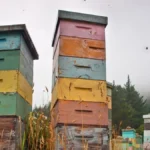
Then the honey flow started and the hive went completely insane. We stacked supers on it, harvested them, came back and found them full again. Eventually we put too many boxes on the hive, the whole stack fell over and the bees absconded.
That is an anecdote, not a recommendation to build two-queen skyscrapers. It does illustrate the relationship between population and crop potential rather well: huge numbers of foragers meeting a huge nectar flow can move an extraordinary quantity of nectar.
Quality Versus Quantity
When we ask how much honey we can get from a hive, we can miss another important question: what is the crop actually worth?
A small harvest of distinctive monofloral or regional honey can sometimes be more valuable than a much larger crop of ordinary honey. Sidr honey is a good example of a honey that commands a large premium in specialist markets, although the old fixed claim that it sells for more than $300 per pound is not a sensible figure to keep because retail prices vary enormously by origin, authenticity, grade, packaging and seller.
I have always felt that beekeepers should be explorers. Find little pockets of biodiversity that give you something genuinely different. If your bees produce 40 pounds of remarkable honey instead of 100 pounds of bland honey, the smaller crop may still be the better business.
If you are working out the economics rather than just the crop, compare that yield with how much beehives cost and the broader question of how many beehives you need to make a living.
Frequently Asked Questions
How much honey does one beehive produce in a year?
There is no fixed amount. As a useful benchmark, USDA reported an average harvested yield of 48 pounds per producing colony in the United States in 2025. Individual hives can produce far less or far more depending on forage, weather, colony strength, management and genetics.
Can one hive produce 100 pounds of honey?
Yes. A strong colony on an exceptional nectar flow can exceed 100 pounds of surplus honey, and unusually productive sites can produce much more. That is not a sensible yield to assume for every hive or every season.
Why do some beehives produce much more honey than others?
The biggest differences usually come from nectar availability, distance to forage, weather, colony population, queen performance, swarm control, disease and parasite pressure, and whether the beekeeper gives the colony enough storage space at the right time.
Does putting more supers on a hive make more honey?
Not by itself. Supers provide storage space; they do not create nectar or extra foragers. Add them when a strong colony is entering a good flow and the existing honey-storage space is filling.
Should I feed sugar syrup to increase my honey crop?
Feeding can be useful when colonies genuinely need support or when a beekeeper is deliberately stimulating brood rearing, but syrup must not contaminate honey intended for harvest. Local rules and seasonal management also matter, so feeding should have a clear purpose rather than being an automatic honey-production shortcut.

Dr Garth A. Cambray is a beekeeper, biotechnologist and researcher with nearly three decades of practical beekeeping experience. He holds a PhD in Biotechnology from Rhodes University and has worked extensively in honey production, fermentation biotechnology and value-added bee products. View Dr. Garth Cambray’s credentials, research and experience.
Ready to Start Beekeeping?
Take the next step with our free beginner beekeeping guide. Learn what equipment you need, how to set up your first hive and what to expect during your first season.