
Choosing your first beehive can be surprisingly confusing. Ask five beekeepers which hive is best and there is a reasonable chance you will receive six opinions.
The truth is that there is no perfect hive for every beekeeper. Your climate, physical strength, budget, goals and access to replacement equipment all influence which design makes the most sense. If you are still working through those first decisions, our beginner beekeeping guide puts hive choice into the wider context of starting your first colony.
For most beginners, I would start with a Langstroth hive. It is widely used, easy to source parts for, straightforward to inspect and supported by an enormous amount of equipment and beekeeping knowledge. Top Bar and Warré hives can suit people interested in natural-comb management, while the Flow Hive can make honey harvesting considerably easier if your budget allows.
If you are still working through the basics of getting started, this decision becomes much easier once you understand our plain-English beginner beekeeping guide, especially during your first season.
TL;DR: Which Beehive Type Is Best?
| Hive type | Best for | Main advantage | Main drawback |
|---|---|---|---|
| Langstroth | Most beginners | Standardised, widely supported and easy to expand | Full boxes of honey can be very heavy |
| Top Bar | Natural-comb beekeeping and less lifting | Horizontal design and simple construction | Non-standard equipment and more delicate comb |
| Warré | Lower-intervention beekeeping | Compact vertical design that encourages natural comb | Less standardised and can involve lifting stacked boxes |
| Flow Hive | Beekeepers wanting easier honey harvesting | Honey can be harvested without removing conventional honey frames | Much higher initial cost |
| Bee skep | Historical interest, decoration or some swarm-catching uses | Simple traditional construction | Fixed comb makes modern hive management difficult and may not comply with local rules |
For a new beekeeper who simply wants a dependable first hive, Langstroth remains my first choice.
What Are the Most Popular Types of Beehives?
The Langstroth hive remains the dominant managed-hive design across much of the world, particularly in North America. Its standardised removable frames and stackable boxes make it practical for beginners, hobbyists and commercial beekeepers alike.
In Britain, the National Hive is another familiar design, while Top Bar and Warré hives have developed loyal followings among beekeepers who prefer natural comb and different management styles.
The Flow Hive is newer. It is essentially a modern Langstroth-style hive system with specially designed Flow Frames in the honey super, allowing ripe honey to be drained from those frames without removing and extracting them conventionally.
Each system solves a slightly different problem, which is why the “best” hive depends on what you want from your bees.
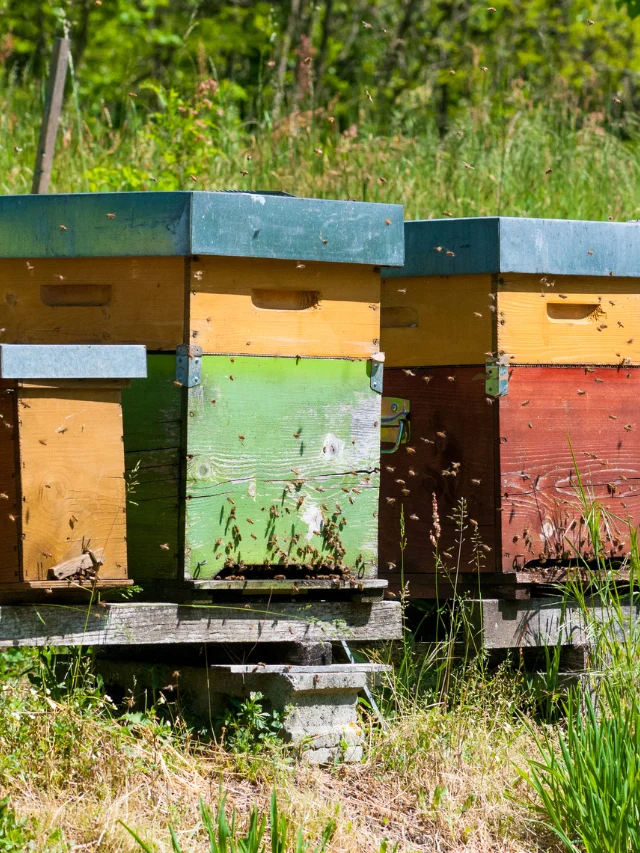
1. Langstroth Hive: Best Beehive for Most Beginners
The Langstroth is the classic removable-frame hive developed from the work of Rev. Lorenzo Lorraine Langstroth in the 19th century. Its major breakthrough was the practical use of bee space, allowing frames to be removed and inspected without the bees permanently attaching everything together.
That basic principle still works extremely well. If brood boxes, supers, frames and bee space are still unfamiliar, our guide to what a honey bee hive looks like shows how the main parts fit together.
Langstroth equipment is modular. Brood boxes, honey supers, frames, feeders, queen excluders and other accessories are readily available, and standardisation means replacement equipment is much easier to find than it is for less common hive systems. If you are deciding what should go in those frames, our comparison of plastic vs wax foundation explains the main trade-offs.
That becomes surprisingly important once you have bees. If you urgently need another super during a major nectar flow, you will appreciate being able to buy one rather than going home to construct a bespoke box. The guide to how much beehives cost gives the budget side of those equipment choices.
Langstroth Hive Pros
- Excellent choice for beginners
- Removable frames make inspections straightforward
- Widely available equipment and replacement parts
- Easy to expand vertically as the colony grows
- Compatible with feeders, queen excluders, traps and other equipment
- Honey frames can be extracted and returned to the colony
- Large body of books, videos and experienced beekeepers available to help
- Suitable for hobby and commercial beekeeping
Langstroth Hive Cons
- Full honey supers can become extremely heavy
- Regular inspections may involve removing several stacked boxes
- Extracting honey conventionally usually requires additional equipment
- Foundation and framed comb provide less freedom of comb shape than completely foundationless systems
- Different Langstroth formats, such as 8-frame and 10-frame equipment, are not always interchangeable
For most people learning beekeeping, those drawbacks are outweighed by the enormous practical advantage of working with a common, well-supported system.
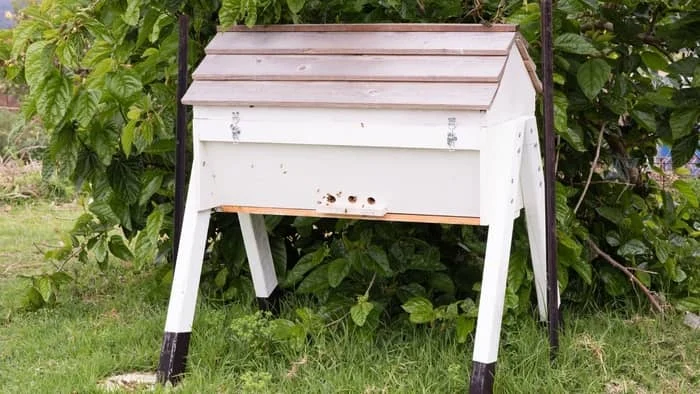
2. Top Bar Hive: A Horizontal Alternative
A Top Bar hive takes a very different approach. Instead of stacking boxes vertically, the colony develops horizontally inside a long hive body.
The bees generally build their comb downward from individual top bars rather than inside four-sided Langstroth frames. This allows naturally constructed comb while still giving the beekeeper access to individual combs for inspection.
One attraction is working height. You generally do not need to remove a 50-pound box of honey just to reach the brood nest because the colony is spread horizontally in front of you.
Top Bar hives can also be relatively simple to construct, although there is much less standardisation between designs.
Top Bar Hive Pros
- Little or no heavy box lifting
- Bees can construct natural comb
- Relatively simple hive construction
- Individual combs can still be inspected
- Honey can be harvested by crushing and straining, so an extractor is unnecessary
- Comfortable working height when mounted on suitable legs
Top Bar Hive Cons
- Dimensions are less standardised
- Replacement components may need to be custom-made
- Fresh natural comb can be delicate, particularly in hot weather
- Management techniques differ from conventional Langstroth beekeeping
- You cannot simply add conventional honey supers in the same way
- Crush-and-strain harvesting destroys that section of comb, meaning bees must rebuild it
- The long hive requires more horizontal space
Top Bar hives can work very well, but I would not automatically describe them as easier than a Langstroth. They are simply easier in different ways.
3. Warré Hive: The People’s Hive
The Warré hive was developed by French priest and beekeeper Abbé Émile Warré after extensive experimentation with hive designs. He called the final design the Ruche Populaire, or People’s Hive, and described its construction and management in L’Apiculture Pour Tous — Beekeeping for All.
Its appearance is somewhat like a compact Langstroth because several boxes are stacked vertically. Inside, however, traditional Warré management generally uses top bars rather than full removable frames, allowing the bees to build natural comb downward.
One of its distinctive management techniques is nadiring. Instead of always adding empty boxes above the colony, additional boxes can be added underneath as the colony expands downward.
A traditional Warré also has a quilt above the upper box, providing insulation and helping manage moisture.
Warré Hive Pros
- Encourages natural comb construction
- Simple, compact box design
- Can be built relatively economically
- Insulated quilt is an integral part of the traditional design
- Management philosophy can involve less frequent disturbance
- Honey can be harvested without owning a conventional frame extractor
Warré Hive Cons
- Less common than Langstroth equipment
- Replacement parts may be difficult to source locally
- Natural comb requires careful handling
- Nadiring can require lifting the occupied hive boxes
- Management differs from what many mainstream beekeeping courses teach
- Equipment may not be interchangeable with neighbouring beekeepers’ hives
If Warré beekeeping appeals to you, a useful companion to this topic is our starter Warre versus Langstroth comparison, which covers the choice in considerably more detail.
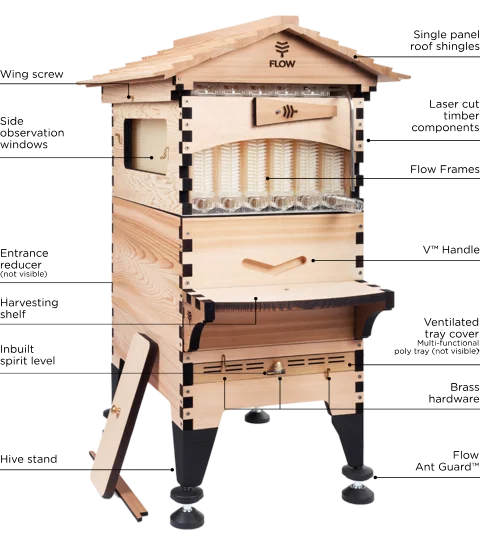
4. Flow Hive: Best for Easier Honey Harvesting
The Flow Hive was developed in Australia by father-and-son beekeepers Stuart and Cedar Anderson. Its defining feature is the Flow Frame: a specially designed partially formed comb system in the honey super that allows ripe honey to drain through a tube when the mechanism is operated.
This can remove much of the conventional work involved in harvesting honey. There is no need to remove each Flow Frame, uncap it, run it through an extractor and then return it to the hive.
The important thing for beginners to understand, however, is that a Flow Hive does not automate beekeeping.
You still need to inspect the brood nest, monitor colony health, recognise queen problems, manage swarming and deal with pests and diseases exactly as you would with other managed bees. The Flow mechanism changes honey harvesting; it does not remove the beekeeper from beekeeping.
The current Flow Hive 2+ is made from western red cedar, with Flow listing approximately 18 kg maximum honey capacity for its six-frame super and approximately 21 kg for its seven-frame super.
Flow Hive Pros
- Very convenient honey harvesting
- Honey can be collected in relatively small batches
- Avoids conventional uncapping and extraction for Flow Frames
- Less honey-processing equipment is required
- Observation windows help you see activity around the Flow super
- Attractive, well-finished hive system
- Based around familiar Langstroth-style hive dimensions
Flow Hive Cons
- Considerably more expensive than a basic conventional hive
- Flow Frames use food-grade plastic components rather than traditional wax comb alone
- The mechanism needs to be maintained and used correctly
- You still need normal brood inspections
- Beginners can mistakenly believe visible honey in the Flow super means the entire colony is healthy
- Conventional frames and equipment may still be needed elsewhere in the hive
If this is one of the systems on your shortlist, our field-tested practical Flow Hive review looks much more closely at what it is actually like to own and manage one.
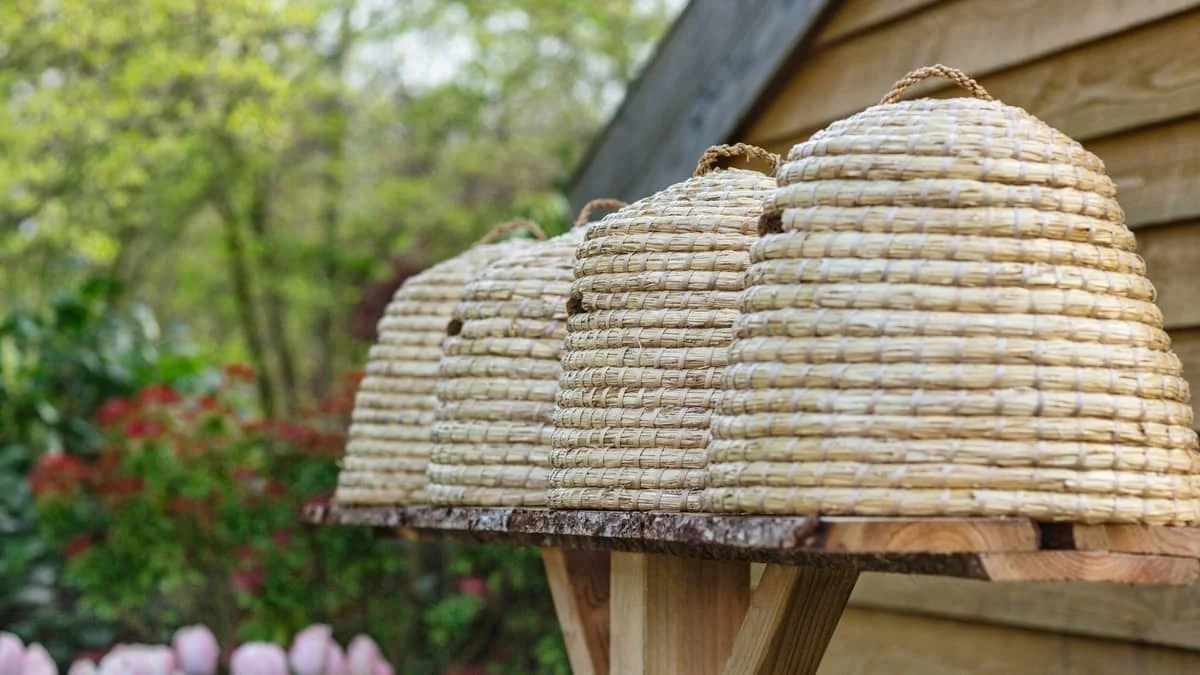
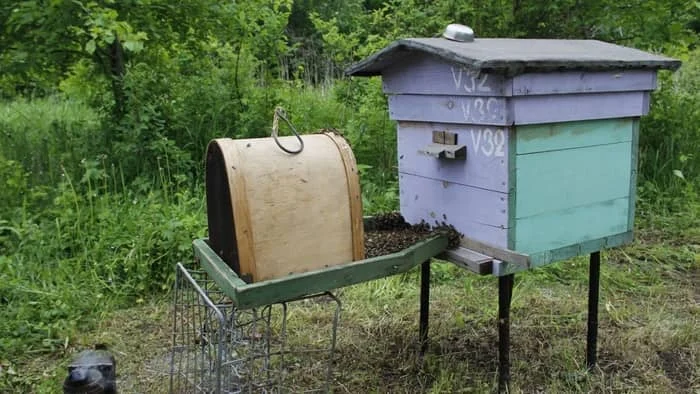
5. Bee Skep: Historically Important, but Not a Good Modern Hive
The classic straw bee skep is probably the most recognisable symbol of beekeeping. Humans kept bees in woven or coiled basket-style hives for centuries before removable-frame hives became standard.
They are beautiful objects and an important part of beekeeping history.
They are not, however, what I would recommend for somebody establishing a modern managed colony.
The major problem is fixed comb. Without removable frames, thoroughly inspecting brood comb for disease, queen condition and other colony problems becomes extremely difficult.
Traditional honey harvesting from skeps could also be highly destructive. Modern beekeeping practices and regulations in many places require colonies to be maintained in a way that allows inspection, so you need to check your local regulations before contemplating keeping bees permanently in one.
Bee Skep Pros
- Historically significant design
- Made from simple natural materials
- Attractive as decoration
- Can have specialised uses, such as temporary swarm collection
Bee Skep Cons
- Fixed comb makes thorough inspections difficult
- Cannot be expanded conveniently like a modular hive
- Modern disease-management practices are difficult
- Traditional harvesting methods could destroy comb and colonies
- May fail to comply with local beekeeping regulations
- Poor choice for a beginner’s managed production colony
Enjoy skeps as part of beekeeping history. For your first functioning apiary, choose something you can actually open and inspect.
Langstroth vs Top Bar vs Warré vs Flow Hive
If you are still torn between them, I would think about the decision this way.
Choose a Langstroth if…
You want the simplest route into mainstream beekeeping, easy access to parts and equipment, and the ability to learn from almost any experienced beekeeper.
For most beginners, this is my recommendation.
Choose a Top Bar hive if…
You particularly value horizontal working, natural comb and avoiding heavy stacked boxes, and you do not mind learning management techniques that differ from conventional Langstroth beekeeping.
Choose a Warré hive if…
You are interested in natural-comb, lower-intervention beekeeping and are comfortable adopting a somewhat less common management system.
Choose a Flow Hive if…
You like the advantages of a Langstroth-style colony but want a much easier method of harvesting honey and are comfortable paying substantially more for the equipment.
Choose a skep if…
You want something beautiful for the garden or are fascinated by historical beekeeping.
For actually learning modern hive management, choose one of the other four.
What Should a Beginner Look for in a Beehive?
Your hive should suit both the bees and the beekeeper.
Local support and replacement parts
This is one of the most underrated considerations. If every beekeeper in your local club runs Langstroths and you turn up with a highly specialised hive nobody has seen before, getting emergency equipment or hands-on advice becomes harder.
Standard equipment is boring right up until you urgently need some. Our guide to beekeeping equipment and tools for beginners covers the other items you are likely to need alongside the hive itself.
Weight
Honey is heavy.
A completely full conventional super can become uncomfortable or impossible for some people to lift safely. If lifting is an issue, consider 8-frame Langstroth boxes, shallower supers, a horizontal hive or another arrangement that lets you manage smaller loads.
How you want to harvest honey
If your objective is substantial honey production, conventional removable frames are extremely practical because extracted comb can be returned to the colony and reused.
If you prefer occasional small harvests, crush-and-strain systems may be perfectly adequate. If avoiding extraction equipment is particularly important, that may push you toward Top Bar, Warré or Flow systems.
Your climate
Hive design matters, but good colony management matters more.
Ventilation, insulation, stores, moisture management and entrance configuration all need to suit the climate in which your bees actually live. Avoid assuming a hive advertised as “natural” or “insulated” automatically solves winter or summer management for you.
Your long-term plans
Your first hive has a habit of becoming two.
And then four.
A non-standard hive that was entertaining to build once may become considerably less entertaining when you need another five boxes, 40 bars and a replacement roof by Saturday.
If you are thinking about buying everything together rather than piece by piece, our practical beehive starter kits with bees guide shows how the hive itself fits into the rest of a beginner setup.
What About Observation Hives?
An observation hive belongs in a slightly different category because its primary purpose is allowing people to observe bees, rather than acting as the normal production hive you would keep in an apiary.
They can be fascinating educational tools and let you see behaviour that normally occurs deep inside a colony. They also introduce their own considerations around colony size, ventilation, access and how bees enter and leave the building or enclosure.
To avoid treating this choice in isolation, use our real-world observation hive guide for hive types to understand where observation hives fit beside conventional hive designs.

So, Which Beehive Is Best for a Beginner?
For most new beekeepers, I recommend a Langstroth hive.
It is not because Langstroth is perfect. It is because your first season already involves learning bee behaviour, inspections, queens, brood, swarming, honey stores, pests, diseases and the strange ability bees have to do exactly what you were told they would not do.
Using a widely supported hive removes one unnecessary complication.
If you have a particular reason for choosing something else, that is different. A Top Bar hive can be excellent where lifting is difficult. A Warré can appeal strongly to someone committed to its management philosophy. A Flow Hive is genuinely convenient if honey harvesting is one of the parts you want to simplify.
The important thing is to choose your hive because it suits how you intend to keep bees, not because one design has been presented as the magical answer to every problem.
Bees have survived quite happily in hollow trees, walls, barrels and some places that make remarkably poor real estate.
The hive usually needs to suit the beekeeper more than the bees.
Beehive Types FAQs
What is the best beehive for a beginner?
For most beginners, a Langstroth hive is the best starting point because equipment is widely available, removable frames make inspections straightforward and most beekeeping courses and experienced beekeepers are familiar with the system. Other hive types can work extremely well, but choosing a common system makes your first season easier.
What is the most popular type of beehive?
The Langstroth is one of the world’s most widely used managed beehive designs and is particularly dominant in North American commercial and hobby beekeeping. Its modular boxes and removable frames have also influenced many other modern hive systems.
Is a Flow Hive better than a Langstroth?
A Flow Hive makes honey harvesting much easier, but it does not eliminate normal hive inspections or colony management. A conventional Langstroth is considerably less expensive and gives beginners access to more interchangeable equipment, while a Flow Hive may appeal to somebody willing to pay more for convenient harvesting.
Are Top Bar hives good for beginners?
They can be. Top Bar hives avoid lifting stacked supers and let bees construct natural comb, but their management differs from conventional Langstroth beekeeping and equipment is less standardised. A beginner with good local Top Bar support may have an excellent experience with one.
What is the difference between a Warré and Langstroth hive?
Both are vertically stacked modular hives, but traditional Warré hives generally use top bars and natural comb, smaller boxes and a different management philosophy. Langstroth hives normally use full removable frames and have much greater equipment standardisation.
Do Flow Hives still need inspections?
Yes. The Flow system changes the way honey is removed from the honey super; it does not replace routine colony management. You still need to inspect brood, monitor colony health, manage swarming and deal with pests, disease and queen problems.
Can I keep different hive types in the same apiary?
Yes, but doing so means keeping different spare parts and learning different management techniques. For beginners, using the same hive system for the first few colonies usually makes equipment management considerably easier.
Are bee skeps illegal?
That depends on your location. Some modern beekeeping regulations require movable or inspectable comb, which can make traditional fixed-comb skeps unsuitable for legally managed colonies. Always check the rules that apply where you live.

Sam Fielding is a BeekeeperTips contributor specialising in beginner beekeeping, hive systems, equipment research and practical buying guides. His articles are developed from established beekeeping practices, reputable agricultural and extension resources, manufacturer documentation and scientific literature where relevant.
Sam’s work focuses on helping new and hobbyist beekeepers understand their options, compare equipment and make better-informed decisions about hive setup and management. You can learn more about his areas of focus, research approach and featured articles on his Sam Fielding’s profile.
Ready to Start Beekeeping?
Take the next step with our free beginner beekeeping guide. Learn what equipment you need, how to set up your first hive and what to expect during your first season.
You Might Also Like:
 Warre Hive vs Langstroth: Which Is Better for Beginners?
 Is the Flow Hive Worth It? Pros, Cons & What Beginners Should Know
 How to Choose a Beehive: Best Types for Beginners
 How Much Do Beehives Cost? Ultimate Beginner Budget Guide
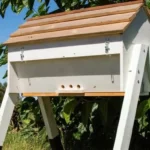 The Ultimate Guide to Ventilating Your Top Bar Hive
 How Much Does It Cost to Start a Bee Farm?