How long can a queen bee live in a cage? A queen can survive for several days in a normal shipping or introduction cage when she has food and worker care, and queens can be banked for weeks under specialised conditions. But survival is not the same thing as good management. If you have bought a queen for a colony, the sensible aim is still to install her as soon as practical. Queen introduction sits within the broader Queen Bees & Swarming guide.
TL;DR: For normal requeening, think in terms of days, not long-term storage. Candy-release cages are designed to delay release while the colony adjusts to the queen. Queen producers can bank individually caged queens for much longer inside strong, carefully managed colonies, but survival and later performance become more variable as storage gets longer. A queen left without adequate food or attendant care can weaken quickly.
If you are learning queen management for the first time, the Beginner Beekeeping guide provides useful background on requeening, colony strength and seasonal management.
Why Do We Cage a Queen?
There are several good reasons to place a queen in a cage. The most common are shipping, introducing her to an unfamiliar colony and temporarily holding queens during queen-rearing work.
The cage itself is not the objective. It is a management tool. Queens are designed to spend their lives surrounded by workers, being fed, groomed and allowed to lay eggs. So, wherever possible, I prefer to move them through the caged stage efficiently.
Introducing a New Queen to a Hive
If you simply drop an unfamiliar queen into a colony, the workers may reject and kill her. A slow-release cage gives the colony time to interact with her through the mesh before direct contact. The goal is to return the colony to a stable queen-right state without the workers rejecting the new queen.
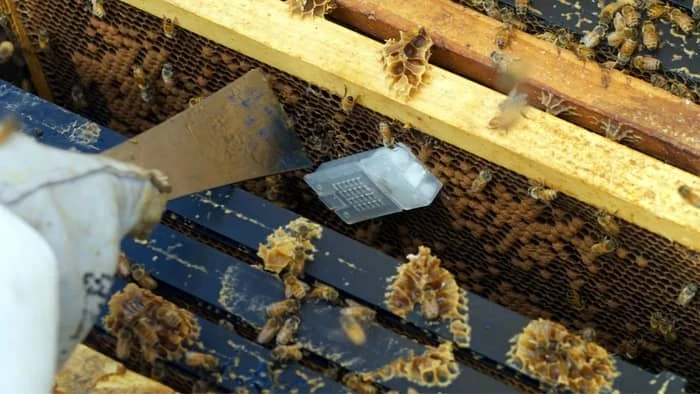
Most introduction cages use a candy plug. Workers gradually chew through the candy while contacting and feeding the queen. This usually delays release for a few days, which improves the chance that the colony will accept her. After release, being able to find the queen during an inspection helps confirm that introduction has succeeded.
A queen in a cage is not laying eggs. Eggs are future bees, bees make honey, so time is honey. That does not mean you should direct-release every queen immediately; it means the introduction should be deliberate rather than unnecessarily prolonged.
How Long Can a Queen Stay Caged?
There is no single biological deadline that applies to every queen cage. The answer depends heavily on food, attendant care, temperature, humidity, cage design and whether the cage is inside a colony.
A queen travelling in a normal shipping cage with attendants and candy can survive for several days. In practical beekeeping, however, that does not make the shipping cage a storage system. Once she arrives, check that she is alive and install her into a prepared colony as soon as practical. The urgency partly depends on how long the recipient hive has been queenless and what brood remains.
At the other end of the spectrum, commercial queen producers and researchers use queen banks. Here, many queens are held individually in cages inside a strong queenless colony where nurse bees can feed them through the mesh.
Research shows that queens can be banked for weeks and, under controlled experimental conditions, even for months over winter. The results are mixed enough that I would not turn that into a recommendation for casual long-term storage. Some studies have recorded reduced survival, temporary ovary shrinkage or slower early brood production, while surviving banked queens can later perform similarly to comparison queens.
The practical conclusion is simple: queen banking is real, but it is specialist management. It is not the same thing as leaving a purchased queen sitting on a desk for a week.
Storing Queens in a Queen Bank
Banking queens means placing individually caged queens into a strong colony with plenty of young workers and food. The workers can care for each queen through the cage mesh while the queens remain physically separated from one another.
This is useful for breeders who have queens ready before customers or mating nuclei are ready for them. It can also help bridge short gaps in a queen-rearing schedule.
Recent research has made the picture more interesting than the simple idea that banking always ruins queens. In one Canadian overwintering study, banked queens had lower survival than queens wintered individually, but the surviving banked queens did not show major long-term differences in several reproductive measures. Another study found poorer brood production early after introduction, with performance becoming more similar later.
So I would not call queen banking either harmless or automatically damaging. The outcome depends on how many queens are banked, cage design, worker access, nutrition, temperature and the length of storage.
If you are raising queens yourself, good scheduling remains easier than unnecessary storage. Our guide to raising honey bee queens covers that broader process.

Can a Queen Survive in a Cage Without Worker Bees?
A queen is nutritionally demanding and normally receives frequent feeding from attendant workers. She is not built to function like a solitary insect with a lunchbox.
If she is isolated without access to appropriate food or attendants, she can weaken rapidly. The risk is not simply whether she remains alive; dehydration, inadequate nutrition and prolonged interruption of normal worker interactions can all reduce the chance of a successful introduction.
For this reason, shipping cages normally include attendants, and queen banks are designed so colony workers can access and feed the caged queens.
How Does the Candy Release Work?
A typical queen-introduction cage has an exit blocked with candy. The hive bees chew through it over time, creating a delayed release.
I used to use a type of toffee that worked well. Other beekeepers use purpose-made queen candy or fondant. The important thing is that the plug creates a delay without trapping the queen indefinitely.
I once had a queen die because the bees propolised the release hole. That is a useful reminder to check that the queen has actually been released rather than assuming the system worked because a few days have passed.
For general sugar-candy preparation, see our guide to making bee candy, although queen-cage candy should be firm, clean and suitable for a small release plug rather than treated as a full colony feed.
Why Smuggling Queens Is Such a Bad Idea
There is always some creative clown who decides they want to smuggle bees. People get insanely fascinated with the different honey bee populations around the world, and collectors can become remarkably inventive.
I once met a man who said he was visiting countries across Africa, buying queens and taking them back to Germany for an “apiary collection” of African bees. The biological risk in moving live bees illegally is enormous.
Imported bees can move parasites, pathogens and unwanted genetics into new regions. The Cape honey bee is a good example of why this matters: Apis mellifera capensis workers have unusual reproductive biology and can become social parasites in susceptible colonies. Legal import rules and quarantine controls exist for good reason.
Can Multiple Queens Live in One Hive?
Under normal conditions, established honey bee queens do not simply tolerate one another in the same brood nest. But beekeepers can configure colonies so that multiple queens operate in separate brood areas while workers share other parts of the hive.
Two-queen systems have a long history in commercial beekeeping. Queen excluders, double screens and separate brood chambers can be used to keep queens apart while allowing a very large combined worker population to use common honey supers.
I knew a chap who took this to a new level. He put three double brood boxes next to each other on the ground, built spacer boards over them and arranged common supers across the top. He then added more brood boxes and queens until the whole contraption contained six queens.
The result was a crazy, steamy mess of foul-tempered angry bees. It produced a bit of honey but was basically an unworkable system done for the sake of doing it. I think he wanted to create a half-a-million-bee beehive.
Wild Multi-Queen Situations
Wild colonies sometimes nest very close together, and large unmanaged nest structures can create situations that look like one enormous hive.
I remember a bee removal I did when I was 19. There was a garden shed with “some bees” in it. I opened the door and an entire wall was covered in bees. What looked like one giant colony actually contained two brood nests separated by a large band of honey.
That sort of observation is different from proving that two laying queens were peacefully sharing one brood nest. In unmanaged cavities, neighbouring colonies can grow into adjacent spaces and appear to merge structurally while retaining separate brood areas.
So, How Long Can a Queen Bee Live in a Cage?
A queen can remain alive in a cage for several days under ordinary shipping and introduction conditions, and specialist queen banks can maintain queens for considerably longer. But “alive” is not the right management target.
For a queen purchased to requeen a colony, install her promptly into a suitable hive and allow a controlled release. If you need to store many queens, use a properly managed queen bank rather than improvising with shipping cages.
Queens are sensitive, demanding creatures. The more quickly we can return them to what they do best — living within a colony and laying eggs — the better.
For the cost side of queen replacement, see how much a queen bee costs.
Queen Cage FAQs
How long can a queen bee live in a cage?
A queen can survive for several days in a normal shipping or introduction cage when she has food and attendant care, and queens can be banked for weeks under specialised colony conditions. Survival alone is not the goal, though: for a purchased queen, install her into a suitable colony as soon as practical.
How long should a new queen stay caged during introduction?
Candy-release methods commonly delay release for a few days so the colony can adjust to the queen before direct contact. The exact timing depends on the cage, colony condition and how quickly the candy is removed.
Can a queen bee survive in a cage without worker bees?
Not for long under ordinary conditions. Queens normally depend on worker attendants for feeding and care. A queen isolated without access to suitable food or attendants can weaken rapidly.
What is queen banking?
Queen banking is the practice of holding multiple individually caged queens inside a strong colony so workers can feed and care for them through the cage mesh. It is used by queen producers and researchers when queens must be stored temporarily.
Does queen banking damage queens?
It can affect queens, especially when storage is prolonged or the bank is poorly managed, but the outcome is not universally damaging. Recent studies show that some banked queens can later perform comparably with control queens, although survival and early brood production may be more variable.
Why is candy used in a queen cage?
Candy provides a delayed release. Workers gradually chew through the plug while interacting with the queen through the cage, giving the colony time to adjust before she is released.
Should I release a queen immediately from her cage?
Usually not when introducing her to an unfamiliar colony. A direct release can increase the risk of rejection. Follow the supplier’s introduction instructions and use the colony’s behaviour and queenless status to guide release.
Can more than one queen live in the same hive?
Yes, but only under particular biological or management conditions. Beekeepers can operate two-queen or multi-queen systems by separating queens with screens, excluders or separate brood areas while allowing workers to share supers.

Dr Garth A. Cambray is a beekeeper, biotechnologist and researcher with nearly three decades of practical beekeeping experience. He holds a PhD in Biotechnology from Rhodes University and has worked extensively in honey production, fermentation biotechnology and value-added bee products. View Dr. Garth Cambray’s credentials, research and experience.
Ready to Start Beekeeping?
Take the next step with our free beginner beekeeping guide. Learn what equipment you need, how to set up your first hive and what to expect during your first season.