Bees Around the home and garden
Create a Bee-Friendly Garden and Enjoy a Happier, Healthier Environment
Discover how to make your garden, backyard or smallholding a safer and more welcoming place for bees. Learn which plants attract bees, how to provide water, what to avoid and how to live alongside bees responsibly.
Plant for pollinators
Create a safe environment
Support healthier bees
Printable checklist, inspection report & seasonal guidance
Bees Around the Home
Create a Bee-Friendly Garden and Enjoy a Happier, Healthier Environment
Discover how to make your garden, backyard or smallholding a safer and more welcoming place for bees. Learn which plants attract bees, how to provide water, what to avoid and how to live alongside bees responsibly.
Printable checklist, inspection report & seasonal guidance
The Beginner Beekeeping Roadmap
1.
Understand why bees matter
2.
Choose bee-friendly plants
3.
Provide water safely
4.
Keep your garden safe for bees
5.
Work with your neighbours
6.
Avoid harmful chemicals
7.
Recognise common bee species
8.
Manage nests responsibly
9.
Support bees through the seasons
10.
Enjoy the benefits
Garden Principle:
Small changes in your garden can make a big difference for bees.

Understand Why Bees Matter
Bees are some of the most important pollinators in our gardens, farms and natural environments.
They help fertilise flowers so plants can produce seeds, fruit and new growth. Honey bees are only part of the story. Bumblebees, mason bees, leafcutter bees and many other solitary bee species also make an enormous contribution to pollination.
A bee-friendly garden does not need to be wild or untidy.
It simply needs to provide some of the resources bees are looking for:
- flowers;
- pollen;
- nectar;
- water;
- nesting opportunities;
- shelter;
- reduced chemical exposure.
The more diverse your garden is, the more useful it can become to different bee species.

Choose the Right Plants
The most useful bee garden is one that provides flowers over a long period rather than producing one spectacular burst of flowers for a few weeks.
Different bee species also prefer different flowers.
Some bees can access deep tubular flowers while others work better on flatter, more open blooms.
Think about creating a mixture of:
- flowering trees;
- shrubs;
- herbs;
- annual flowers;
- perennial flowers;
- vegetables;
- ground covers;
- native species;
- flowering weeds where appropriate.
The exact plants that work best will depend on your local climate.
Rather than looking for one perfect bee plant, try to create a sequence of flowering plants so there is something available throughout the season.
Best Plants for Honey Production →

Turn Part of Your Lawn Into Bee Habitat
A traditional lawn can look neat, but from a bee’s perspective it can be a fairly uninteresting place.
Replacing even a small area with flowering plants can dramatically increase the amount of usable forage.
A wildflower section, flowering border or patch of low-growing herbs can provide nectar and pollen while still fitting into an attractive garden.
You do not need to replace the whole lawn.
Start with one corner.
A small patch that flowers for months can often be more useful to bees than a much larger area of short-cut grass.

Provide Water for Bees
Bees need water for a number of reasons.
Honey bees use it to:
- cool the hive;
- dilute stored honey;
- support normal metabolism;
- regulate temperature during hot weather.
If your garden contains a swimming pool, pet bowl, bird bath or dripping tap, bees may discover these before they discover the water source you would prefer them to use.
That is why it is useful to provide bee water deliberately.
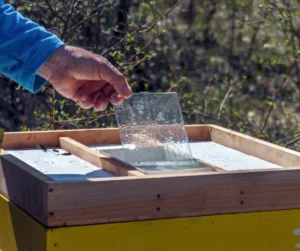
A simple bee watering station can contain:
- shallow water;
- stones;
- gravel;
- floating corks;
- sticks or other safe landing surfaces.
The objective is to provide access to water without creating a drowning hazard.

Create Habitat for Solitary Bees
Not every bee lives in a large colony.
Many bee species are solitary.
A single female may build her own nest, provision individual cells with pollen and nectar and lay an egg in each chamber.
Mason bees and leafcutter bees are good examples.
These bees can often be encouraged into gardens by providing suitable nesting spaces.
Bee hotels
Bee hotels can provide cavities for solitary bees, but they need to be designed and maintained sensibly.
Poorly built bee hotels can concentrate pests and disease rather than helping bees.
Mason bee nesting holes
Hole diameter matters when building nesting blocks.
Different solitary bee species prefer different cavity sizes.
Mason bees
Mason bees are excellent pollinators and can be particularly useful in gardens and orchards.

Learn to Identify the Bees Around You
One of the easiest ways to become more comfortable around bees is to learn what you are actually looking at.
Many insects are casually called “bees” even when they are not bees at all.
Around a garden you may encounter:
- honey bees;
- bumblebees;
- mason bees;
- leafcutter bees;
- carpenter bees;
- long-horned bees;
- wasps;
- yellow jackets;
- bee-mimicking moths and flies.
Correct identification matters because the appropriate response to each insect may be very different.
A solitary bee visiting flowers is usually nothing to worry about.
A honey bee colony living inside a house wall is a completely different problem.

Understand Bee Nests
Bees can nest in many different places.
Honey bees may choose:
- hollow trees;
- wall cavities;
- roof spaces;
- chimneys;
- sheds;
- abandoned boxes;
- other enclosed spaces.
Bumblebees and solitary bees may use entirely different nesting sites.
Ground-nesting bees, for example, can create nests directly in soil.
Before trying to remove any nest, identify the insect first.

Bees Nesting in Your House
A colony living inside a wall or roof cavity should be taken seriously.
The bees themselves may not always be the biggest problem.
Comb, honey and brood can remain inside the building even after bees are removed, and unmanaged cavities can attract another swarm later.
Signs that bees may be nesting inside a structure include:
- regular bee traffic through one opening;
- buzzing inside a wall;
- bees appearing inside the house;
- repeated swarming around the same part of the building.
Do not simply block an active entrance.
Trapping bees inside can create more problems.

Remove Bees Responsibly
A swarm hanging temporarily on a tree branch can often be collected easily.
A colony inside a wall may require structural access.
Ground-nesting insects may not even be honey bees.
Where practical, relocation is preferable to simply killing a colony.
Professional beekeepers and bee-removal specialists may be able to remove and rehome honey bees.
Who to Call for Beehive Removal →

Work With Your Neighbours
Bees do not understand property boundaries.
If you keep honey bees in a residential area, your management decisions can affect the people around you.
Good backyard beekeeping includes thinking about:
- flight paths;
- water sources;
- hive placement;
- children;
- pets;
- public areas;
- defensive colonies;
- swarm control;
- local laws.
A well-managed hive can often coexist quite comfortably with neighbours.
A badly positioned or badly managed hive can create unnecessary conflict.
Providing water before bees discover a neighbour’s swimming pool is one of the simplest examples of good neighbour management.

Avoid Unnecessary Chemical Exposure
Garden chemicals can affect bees directly or indirectly.
The greatest risk usually occurs when insecticides are applied to flowering plants while bees are actively foraging.
If chemical treatment is genuinely necessary:
- follow the product label;
- avoid spraying open flowers where possible;
- avoid spraying while bees are actively foraging;
- use the least disruptive method that will solve the problem;
- avoid assuming every insect is a pest.
Integrated pest management is generally a better approach than routine spraying.
A healthy garden contains insects.
The objective is not to sterilise the landscape.

Know When a Bee Is Actually a Problem
Seeing bees around flowers does not mean you have a bee problem.
In most cases, bees foraging in a garden are simply doing what you want them to do.
Intervention becomes more reasonable when:
- a nest is inside a building;
- people are at genuine risk;
- a colony has become dangerously defensive;
- bees repeatedly enter living spaces;
- a nest interferes with essential access;
- the species presents a genuine local safety concern.
The first step should still be identification.
Bumblebees Around Your Home
Bumblebees are usually temporary visitors.
Their colonies are generally seasonal and much smaller than honey bee colonies.
If a nest is somewhere inconvenient, relocation or simply waiting for the colony’s natural cycle to finish may be better than destroying it.
Africanized Honey Bees
In areas where Africanized honey bees occur, identification and risk management become more important.
These bees cannot usually be identified reliably by casual visual inspection alone, but colonies may behave more defensively than commonly managed European honey bee strains.
If you suspect a highly defensive colony near a home, involve experienced local professionals.
Where to Go Next
Explore the key home, garden and pollinator topics in more detail.
Bee-Friendly Plants
Bee Identification
Water & Habitat
Nests & Removal
Neighbours & Safety
Frequently Asked Questions
The best plants are those that provide useful nectar or pollen and grow well in your local climate. A mixture of trees, shrubs, herbs, annuals and perennials that flower at different times is generally more useful than relying on one species.
Grow bee-friendly flowers, provide a safe water source, reduce unnecessary insecticide use and create nesting opportunities for solitary bees. Plant diversity and a long flowering season are particularly helpful.
Yes, especially during warm or dry weather. Use shallow water and provide stones, corks or other safe landing surfaces so bees can drink without drowning.
They can be useful when correctly designed and maintained. Poorly maintained bee hotels can concentrate parasites and disease, so clean design, suitable hole sizes and regular maintenance matter.
First identify the insect and confirm whether you have an established colony. Do not simply seal the entrance while bees are active. A beekeeper or experienced bee-removal professional may be able to remove the colony and advise on preventing another swarm from occupying the cavity.
Many ground-nesting bees are solitary and relatively docile, but some insects described as “ground bees” may actually be wasps or yellow jackets. Correct identification should come before control.
Normally, no. Bees visiting flowers are beneficial pollinators and usually present little risk. Removal or control may be justified when a colony is in a dangerous location or presents a genuine safety problem.
Provide an attractive alternative water source before the bees establish the pool as their preferred location. Keep the alternative source consistently filled and give bees safe landing surfaces.
Most bee species contribute to pollination, but different bees specialise in different plants and conditions. Honey bees are important generalist pollinators, while bumblebees, mason bees, leafcutter bees and other solitary bees can be especially efficient on certain crops and flowers.
In many places, yes, but local laws and registration requirements vary. Good hive placement, reliable water, responsible colony management and consideration for neighbours are essential.
Bees Around the Home Most Popular Articles

Is the Flow Hive Worth It? Pros, Cons & What Beginners Should Know

Buying Honey Bees: Packages vs Nucs for Beginners

How Much Honey Per Frame?

The 7 Best Bee Feeder Types Available to Beekeepers

Want Bees? Here’s How to Get Them for Free or Cheap

Does Bee Pollen Expire? Storage and Safety Guide

How Long Does It Take Bees to Make a Hive?

When Not To Open A Beehive? – Tips To Avoid Catastrophes

Bees Left Behind After a Swarm

Ultra Bee Pollen Substitute: When and How to Use It

When Is Honey Harvested?