
How long do bees live without a hive? There is no single countdown. A healthy honey bee that becomes separated from her colony can keep flying and feeding while conditions are suitable, but cold, exhaustion, lack of forage, injury and simply being unable to find home can shorten that time dramatically. A bee that is chilled or has run out of usable energy can become grounded quite quickly.
We have all seen a sad-looking bee stuck against a car window, released her, and then watched her buzz around as though the entire landscape has suddenly become unfamiliar. So let us look at what actually happens to lost bees, how long they can manage without food, and when bees normally head home.
TL;DR: Honey bees are social insects and are not adapted to live independently of a colony. There is no reliable rule that a lost bee dies after a set number of hours: temperature, energy reserves, access to nectar or sugar, weather and the bee’s condition all matter. If you find an exhausted bee, shelter or a nectar-rich flower is usually the first option; a tiny drop of plain white-sugar water can be used as a short-term energy boost. Do not feed a found bee honey of unknown origin.
How Long Do Bees Live Without a Hive?
A worker honey bee can certainly survive away from the hive for a period of time — foragers do this every day — but that is very different from living permanently without a colony. Honey bees are eusocial animals. Their food sharing, temperature control, brood care, defence and reproductive biology all work as parts of a colony rather than as the life of a solitary insect.
For a genuinely lost bee, the practical answer is therefore “as long as conditions allow her to keep functioning.” A warm bee with access to flowers may remain active much longer than a chilled bee on a cold surface. It is better to think in terms of the things that limit survival than to give a fixed number of hours that nature will promptly ignore.
Cold Bees
Cold is one of the quickest ways to turn a flying bee into a crawling bee. As the bee cools, her flight muscles can no longer produce the power needed for flight, so she may sit or crawl even though she is still alive. This is why a bee that appears exhausted on a cold morning can sometimes become active again once the day warms.
If you want to help, move the bee gently with a spoon or piece of card to a sheltered place where she can warm naturally. If suitable flowers are nearby, placing her on a flower gives her a chance to feed for herself. Avoid trapping the bee in a sealed container or leaving her beside a deep pool of syrup where she can become coated or drown.
Trapped or Exhausted Bees
Bees can also become trapped in sheds, houses, vehicles or around artificial lights and simply burn through a lot of energy trying to escape. Once exhausted, the bee may sit still or crawl rather than fly. In that situation, getting her outdoors into shelter and near flowers is usually more useful than keeping her in a bottle.
If there are no useful flowers and the bee is clearly exhausted, a tiny drop of plain white-sugar water can provide short-term carbohydrate. It is a rescue measure, not a substitute for a hive or normal forage. If you keep bees yourself and want the broader principles of feeding colonies, see our guide to making sugar water for bees.
Can a Honey Bee Live Independently of a Hive?
Not in the same sense as a solitary bee. A worker honey bee may forage, rest and feed away from the colony, but she belongs to a social system in which the queen, brood and other workers continually influence behaviour and physiology. Queen and brood pheromones are among the signals that help maintain normal worker reproductive physiology.
When a colony becomes queenless, some workers can eventually activate their ovaries and lay unfertilised eggs, but that is a colony-level response that develops over time — not something that automatically happens to every worker that gets lost for an afternoon. If you are dealing with a colony that has actually lost its queen, this is a different problem and our guide on how long a hive can be queenless explains it in more detail.
A lost worker may also drift into another colony. Guard bees use odour and contact cues to assess incoming bees, and foreign workers may be challenged or rejected, but drifting between colonies does occur. So the old idea that every lost bee which approaches another hive is automatically killed is too simple.
How Long Do Bees Live Without Food?
Flying is energetically expensive, which is why a forager normally leaves the hive with fuel and then tops up on nectar as she works flowers. The distance a bee can forage is not a fixed “fuel tank” number. It changes with the distribution and quality of forage, weather, wind and the needs of the colony.
Honey bee foragers commonly work within a few miles of the colony when they need to, although much shorter trips are preferable when good forage is close. Once a bee has depleted her readily available energy, she may become unable to fly before she is literally at the point of starvation. Cooling then makes the problem worse because a grounded, chilled bee has less chance of reaching another flower.
This is also why a small amount of sugar water can sometimes appear to produce a dramatic recovery. You are not curing a disease or “reviving” a dying bee; you may simply be giving an energy-depleted insect enough carbohydrate to warm up and fly again. Bees are wonderfully resourceful when you give them half a chance.
Bee navigation is a subject in its own right. If you want to understand some of the visual equipment they use, have a look at how compound eyes work in bees.
How Can a Bee Get Lost?
There are many ways. Beekeepers move hives, and a few bees may be away foraging when a colony is moved or may become separated during transport. Bees can be carried in vehicles, trapped indoors, blown off course by strong winds, or simply end up in unfamiliar surroundings after following a rich food source.
Foragers have impressive navigation abilities, but they are not magic. They learn landmarks around the apiary and use celestial and visual information to orient. Move a bee far enough from the landscape she knows and finding home becomes much harder.
What Happens to Lost Bees?
A lost bee may spend time circling, searching and trying to reorient. If she finds flowers, she can refuel and continue searching. Some workers drift into other colonies; others never relocate their original hive. Predation, bad weather, exhaustion and simple bad luck all become more important the longer a bee remains away from shelter.
So I would not say that a lost bee has a guaranteed few hours left to live. Some will perish quickly and some will keep going far longer. As with so many things in beekeeping, the honest answer is that biology gives us a range of possibilities rather than a kitchen timer.
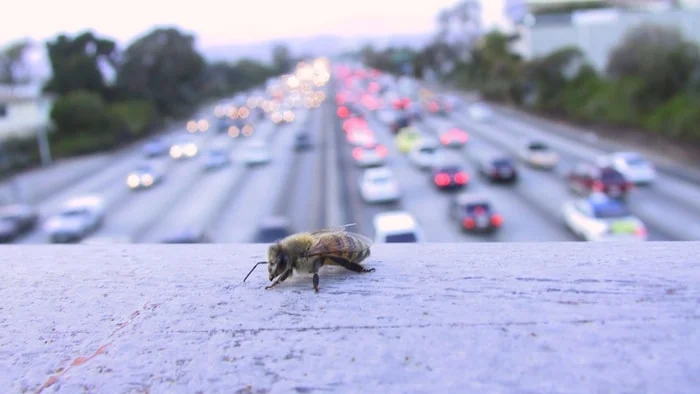
A grounded bee is also more exposed to predators. Our article on yellow jackets and honey bees looks at one group of predators that can cause trouble around colonies.
When Do Bees Go Back to Their Hive?
Bees normally go home when the outside job is done or conditions stop making that job worthwhile. Scouts return with information about forage, nectar and pollen foragers return with their loads, and water and propolis foragers make repeated trips according to what the colony needs. When a good resource is close, some of these trips can be remarkably quick.
Light is an important part of honey bee navigation, so foraging by the western honey bee is predominantly a daytime activity. As evening approaches, activity usually falls and most foragers return to the colony, although temperature, light and the value of the food source can change exactly when the last bees arrive.
Nature, however, enjoys embarrassing anyone who uses the word “always.” I have seen bees continue flying very late when certain Eucalyptus species are flowering close to my hives. Nocturnal orientation has also been documented in the Asian honey bee Apis dorsata under moonlit conditions, so night flight is biologically possible in honey bees even though it should not be treated as normal round-the-clock foraging by every species. The original research can be found here.
How to Help a Tired or Cold Bee Safely
The first thing to decide is whether the bee actually needs rescuing. A stationary bee on a cool morning may simply be warming up, and a bee resting on a flower is doing exactly what bees do. If she is in danger from feet, traffic, water or a window, move her gently to a sheltered spot or a flower.
If she appears exhausted and there is no useful flower available, offer only a very small amount of plain white-sugar water where she can reach it without becoming wet. Do not force-feed her. Once she becomes active, let her leave under her own power.
We may be tempted to use honey because honey seems like the most natural possible bee food. I would not use honey of unknown origin. Honey can carry spores of honey bee pathogens, including Paenibacillus larvae, the bacterium responsible for American foulbrood, and moving unknown honey between bees or colonies is poor biosecurity. The research on American foulbrood spores gives some useful background to why this matters.
And remember that a bee can sting even while you are trying to help her. She has no way of knowing that the giant with the spoon has good intentions. Move her gently, give her space, and do not turn a small act of kindness into a wrestling match.
If you enjoyed this article, please share it with friends who care about bees. The more bees we save, the better we will all bee.

Dr Garth A. Cambray is a beekeeper, biotechnologist and researcher with nearly three decades of practical beekeeping experience. He holds a PhD in Biotechnology from Rhodes University and has worked extensively in honey production, fermentation biotechnology and value-added bee products. View Dr. Garth Cambray’s credentials, research and experience.

Ready to Start Beekeeping?
Take the next step with our free beginner beekeeping guide. Learn what equipment you need, how to set up your first hive and what to expect during your first season.
You Might Also Like:
 How Many Beehives Per Acre? A Practical Guide
 Good vs Bad Bees: Understanding Colony Temperament
 How Long Can a Queen Bee Live in a Cage?
 How Many Beehives Can One Person Manage? A Practical Guide
 What Temperature Do Wasps Stop Flying? [All you need to know]
 How Long Does It Take Bees to Make a Hive?