
How many beehives do you need to make a living? There is no magic number. A beekeeper with 50 colonies selling high-value honey direct to customers may outperform somebody with several hundred hives selling bulk honey at a thin margin. The number you need depends on profit per colony, not hive count alone.
TL;DR: Start small, learn your local production numbers, then scale from real data. Track average honey yield, colony losses, labour hours, travel, feed, treatments, equipment, packaging and selling price. Part-time income operations may run 50 or more colonies, while full-time commercial businesses often need substantially more or a diversified income mix. Do not copy somebody else’s hive number into a spreadsheet and call it a business plan.
If you are still learning the fundamentals, start with the Beginner Beekeeping guide before worrying about commercial scale.
How to Become a Millionaire From Beekeeping
The easiest way to become a millionaire out of beekeeping is to start when you are a multi-millionaire.
Beekeeping is not a get-rich-quick scheme. It can, however, become a good business when you understand your bees, your market and your costs. It is hard, rewarding work, and the best commercial beekeepers tend to be very good at several things at once: animal husbandry, logistics, risk management, sales, maintenance and cash flow.
I have always thought of beekeeping as a get-happy-quick scheme as much as an income source. That does not pay the diesel bill, but it is worth remembering why you wanted to work with bees in the first place.
My First Commercial Lesson: Beekeeping Builds Character
I started keeping bees when I was 19. To build up colonies I did bee removals, taking bees out of houses, trees, military tanks, aeroplanes and other bizarre places they had moved into. I learned a lot about bees, and quite a lot about myself.
One removal involved an ancient oak tree in the garden of the rector of a private school. I could not damage the visible part of the tree, so I dug down and opened the cavity below ground level. I ended up crawling into the space on my back to remove comb.
There was smoke, dirt, honey and a great many angry bees. Honey ran into my eyes and glued my eyelids open. I was stung in places I would prefer not to list in detail. I eventually got the bees out.
That night the ancient oak was struck by lightning and burned to the ground. Life is hard.
I would not recommend that removal as a training method. Bee stings can cause severe allergic reactions, and multiple stings can become a medical emergency. The useful lesson was not that getting stung makes you tougher; it was that difficult bee work teaches planning, patience, problem-solving and respect for risk.

How Many Hives Do You Need to Make a Living?
The honest answer is: work backwards from the income you need.
Penn State Extension notes that successful part-time beekeeping operations aiming to generate income often maintain 50 or more colonies. That is a useful reference point, not a rule. Their enterprise budget also makes the more important point: costs and returns vary enough that each beekeeper needs to substitute local figures.
The basic calculation is:
Required colonies = target annual business profit ÷ average annual profit per productive colony
The hard part is calculating genuine profit per colony. Revenue per hive is not profit per hive.
What Belongs in Profit Per Colony?
| Revenue | Costs and losses |
|---|---|
| Honey sales | Boxes, frames and replacement equipment |
| Pollination income | Feed and colony treatments |
| Nucleus colony or package sales | Queen and colony replacement |
| Queen sales | Labour |
| Wax and other hive products | Vehicles, fuel and transport |
| Bee removals or other services | Extraction, bottling and packaging |
| Training, tours or direct retail | Insurance, compliance, marketing and overheads |
You also need to account for colonies that die, fail to produce a crop, swarm at the wrong time or need resources from stronger colonies. A 200-hive business does not necessarily have 200 hives producing saleable honey every year.
Why 50 Hives Can Beat 500 Hives
Business model matters enormously.
A beekeeper selling distinctive local honey directly to loyal customers can retain much more value from each kilogram than a bulk producer selling drums into a commodity market. A smaller operator may also sell nucleus colonies, queens, wax products, pollination services or education.
A large migratory operation may achieve very high total revenue but also carry significant labour, transport, equipment and finance costs. Neither model is automatically better. What matters is the margin and whether the business can repeat it reliably.
If honey is a major part of your plan, measure your own multi-year production and compare it with the wider issues discussed in how much honey a hive produces.
A Sensible Path From Two Hives to a Business
Stage 1: Learn With a Small Number of Colonies
My general advice is to start with one or two established colonies, with two being particularly useful because you can compare them. Join a beekeeping association, take a good course if one is available and find an experienced beekeeper whose management you respect.
Find an older beekeeper and help them. Beekeepers are divided into two groups: those who looked after their backs when they were young and those who did not. There are a lot in the second group, so you can sometimes lend them your back in exchange for knowledge. Protect yours. You only get one.
Stage 2: Learn the Whole Seasonal Cycle
Do not judge your readiness to scale after one good spring. You need to see swarming, queen problems, nectar flows, dearths, pests, disease, poor weather and the non-productive season in your area.
Track how much time each task takes and how often colonies need intervention. The bottleneck in a growing apiary is often not bee biology but labour at exactly the wrong week of the year.
Stage 3: Test Revenue Before Scaling Colonies
Sell honey while the operation is still small. Find out what customers actually pay, how quickly different package sizes move and how much time you spend bottling, labelling, delivering and standing behind a market stall.
A business that can produce 10 tonnes of honey but can only profitably sell two tonnes has a sales problem, not a bee problem.
Stage 4: Expand From Data
Once you know your average production, loss rate, labour requirement and selling margin, you can decide whether adding another 20, 50 or 100 colonies makes sense.
I would rather see somebody manage 30 healthy productive colonies well than own 100 boxes they cannot inspect on time. Scale introduces new problems: transport, lifting, storage, extraction capacity, disease control, spare equipment and staffing.
Bee Removals as a Second Income Stream
Bee removals can generate useful service revenue and, in some situations, provide colonies that can be rehoused. They also accelerate your education because every feral colony has chosen its own architecture and location.
But removals are not just free bees. Structural cut-outs can involve roofs, ladders, confined spaces, power tools, property damage, difficult clients and public liability. Local laws and insurance matter. Learn the work properly before selling it as a service.
Most importantly, do not treat repeated bee stings as useful conditioning. Some people develop serious venom allergy, and anaphylaxis can be life-threatening. Training should reduce unnecessary exposure, not celebrate it.
Risk Management Is Part of the Business
There are many things that can destroy an apiary: pesticides, bears, people, fire, drought, flood, theft and poor access. Different regions have different versions of the same lesson.
In some of the places I have kept bees, people were the biggest risk. Keeping hives where lions roam can discourage human visitors quite effectively. Unfortunately, lions can also develop an interest in beekeepers. Similar risk trade-offs apply to bears, although with somewhat different paperwork.
Commercial site selection should therefore consider forage, water, vehicle access, theft, neighbours, spray exposure, flood and fire risk, livestock and the ability to move colonies when conditions change.
Write the Business Plan After You Have Real Numbers
A business plan becomes much more useful after you have kept bees long enough to replace guesses with measurements.
Record at least:
- average saleable honey per productive colony;
- average selling price by channel;
- annual colony mortality and replacement cost;
- feed, treatment and queen costs;
- labour hours by season;
- fuel and kilometres per apiary visit;
- extraction and packaging costs;
- equipment replacement and depreciation;
- revenue from pollination, bees, queens or services; and
- the amount of stock you can actually sell.
Then stress-test the plan. What happens after a poor honey year? What if fuel doubles? What if 30% of your colonies need replacing? What if your best market disappears?
Technology That Can Help a Commercial Beekeeper
Remote Hive Monitoring
Precision beekeeping has become a serious field of research. Commercial and research systems can monitor hive weight, temperature, humidity, sound and activity, with the data sent remotely to the beekeeper.
That can be useful when an apiary is far away. A hive scale may show the start of a nectar flow or a major weight loss; temperature or activity data may flag a colony worth checking. The important question is whether the data changes a decision enough to save more money than the monitoring system costs.
Technology does not remove the need to inspect bees. Current reviews of precision beekeeping still describe practical limitations, cost and deployment trade-offs. Sensors are tools, not replacement beekeepers.
Lifting and Handling Equipment
This technology is much less glamorous and often much more valuable. Forklifts, loaders, hive lifters, pallet systems and sensible vehicle design reduce manual handling and increase the number of colonies a person can service safely.
Your back is an asset. Treat it like one.
Traceability
You do not need blockchain to prove where honey came from. Good traceability can be built with apiary records, harvest dates, extraction batches, lot codes and documented movement through the honey house.
Blockchain can be used as one component in a traceability system, but the technology does not make inaccurate source data true. Reliable records and disciplined handling come first.
How Many Hives Can One Person Manage?
Again, there is no universal number. Colony count depends on hive style, apiary density, travel distance, climate, management intensity, migratory work, lifting equipment, extraction systems, staff support and how much of the sales and administration the beekeeper also does.
The fixed claims that one strong person should manage 100–300 hives or one technology-enabled person should manage more than 1,000 are not useful business rules. A beekeeper may physically own that many colonies, but “manage” can mean anything from occasional oversight to intensive queen production.
A better measure is whether every time-sensitive job gets done when it should. If swarm control, supering, queen work, disease treatment or harvest is routinely late, the operation is already beyond its effective capacity.
The Bottom Line
Do not begin by asking how many hives will make you a living. Begin by asking how much profit one well-managed colony contributes to your business.
Learn with a few hives, build your production and sales records, understand your risks, then scale cautiously. Use technology where it removes a real bottleneck, mechanise heavy work before your back sends you an invoice, and build more than one source of revenue where the local market supports it.
And do not forget the fun. If the business grows so large that you hate opening a hive, you may have optimised the wrong variable.
For a basic look at colony equipment and structure, see what a honey bee hive looks like.
Beekeeping for Profit FAQs
How many beehives do you need to make a living?
There is no universal number. A viable full-time business might involve dozens, hundreds or more colonies depending on honey yield, retail versus wholesale pricing, pollination income, bee sales, labour, transport, winter losses and overheads. Build the number from your own profit per colony rather than starting with a target hive count.
Can you make a full-time income from 50 beehives?
Possibly, but not from every business model. Fifty productive colonies can support meaningful part-time income and may form the base of a diversified business, especially with direct retail, nucleus colonies, queens, removals or pollination. Whether they replace a wage depends on local revenue and costs.
How many hives should a beginner start with?
Two colonies is a sensible starting point for many beginners because you can compare colony performance and move resources between hives if needed. The important thing is to learn to manage a small number well before scaling.
Should I expand to 100 hives quickly?
Usually not. Scale only after you know your seasonal workload, average honey yield, winter or annual colony losses, equipment needs, apiary access, disease-management requirements and sales capacity. A hundred poorly managed colonies can lose money faster than ten well-managed ones.
What makes a beekeeping business profitable?
Profit comes from the margin between total revenue and total cost. Important drivers include crop yield, sale price, product mix, pollination or bee-sale income, labour efficiency, transport distance, colony losses, feed, treatments, equipment depreciation, packaging and marketing.
Can bee removals be part of a beekeeping business?
Yes, where local law, insurance, training and access requirements allow it. Removals can provide service income and sometimes bees, but structural removals can involve ladders, cutting into buildings, public liability and significant sting risk. They are not a substitute for learning colony management safely.
Do hive sensors make commercial beekeeping more profitable?
They can help in the right operation. Weight, temperature, humidity, activity and security monitoring may reduce unnecessary trips or provide earlier warning of changes, but the economics depend on apiary distance, equipment cost, data quality and whether the information changes management decisions.
Do you need blockchain to sell premium honey?
No. Traceability matters, but it can be achieved with good batch records, harvest dates, apiary records, lot codes and documented handling. Blockchain is one possible technology, not a requirement for authentic or premium honey.

Dr Garth A. Cambray is a beekeeper, biotechnologist and researcher with nearly three decades of practical beekeeping experience. He holds a PhD in Biotechnology from Rhodes University and has worked extensively in honey production, fermentation biotechnology and value-added bee products. View Dr. Garth Cambray’s credentials, research and experience.
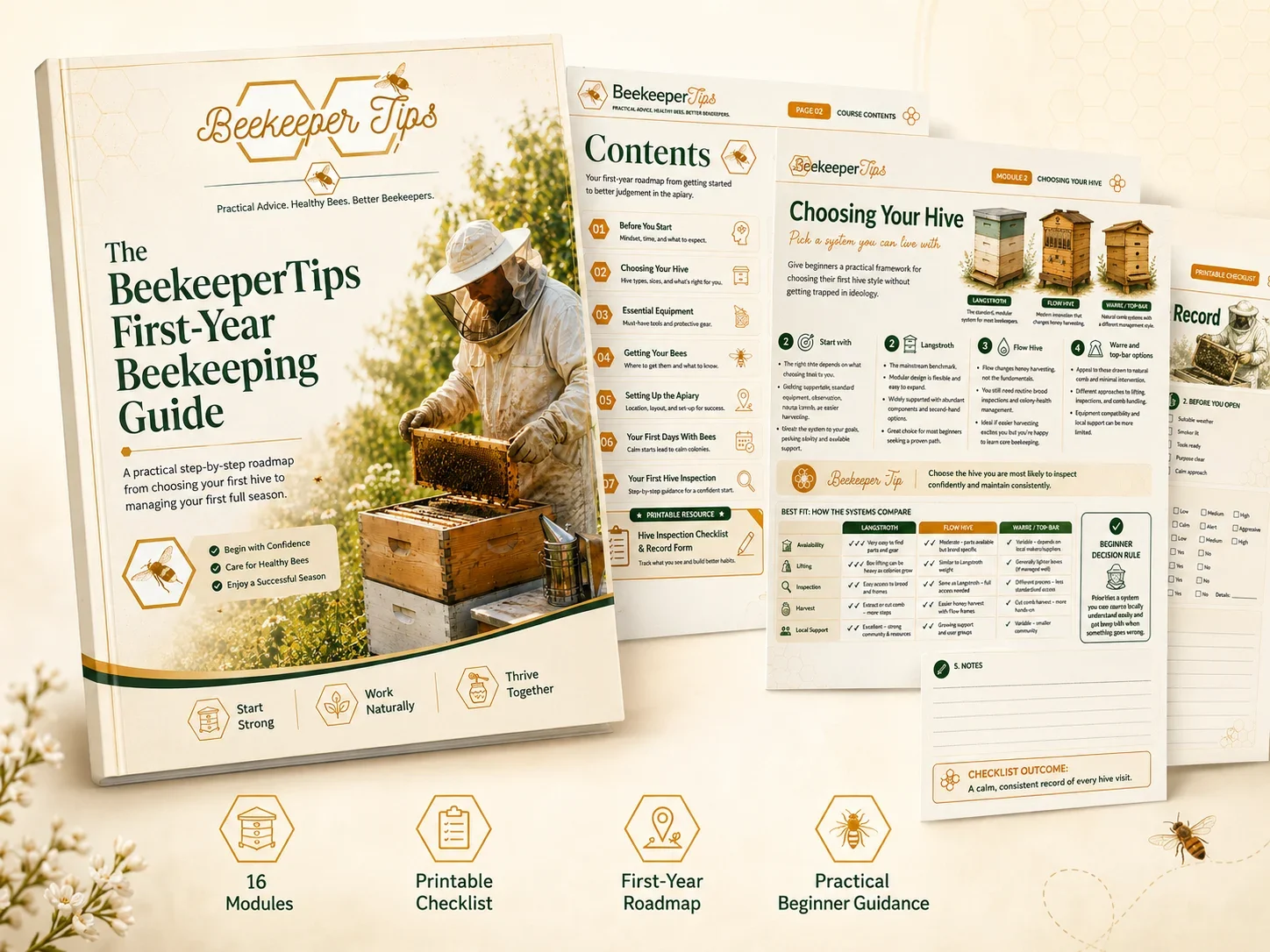
Ready to Start Beekeeping?
Take the next step with our free beginner beekeeping guide. Learn what equipment you need, how to set up your first hive and what to expect during your first season.
You Might Also Like:
 How Many Beehives Can One Person Manage? A Practical Guide
 How Much Does It Cost to Start a Bee Farm?
 How Many Beehives Per Acre? A Practical Guide
 How Much Do Beehives Cost? Ultimate Beginner Budget Guide
 The Shark Tank Beehive: Beethinking Hive Ultimate Innovation
 Warre Hive vs Langstroth: Which Is Better for Beginners?