
Choosing a beehive is easier once you separate hive systems from special equipment. For most beginners, a standard Langstroth hive is still the safest default because parts, frames, nucs, advice and harvesting equipment are widely available. Top-bar and Warre hives can work well for beekeepers who specifically want those management styles, while Flow and Apimaye are variations or specialised versions of removable-frame hive systems rather than completely separate ways of keeping bees. Our Beehives, Equipment & Honey guide places hive choice alongside the frames, tools and harvesting equipment that need to work with it.
TL;DR: Choose Langstroth if you want the easiest path to local support, replacement parts and standard equipment. Choose a top-bar hive if horizontal management and reduced box lifting matter more than interchangeability. Choose a Warre hive if you deliberately want that low-intervention vertical style. Consider Flow if easier honey harvesting appeals to you, and Apimaye if insulation and integrated plastic-hive features justify the higher upfront cost.
If this is your first hive, the Beginner Beekeeping guide is a useful starting point before you buy equipment.
Quick Comparison of Beehive Types
| Hive type | Best fit | Main advantage | Main trade-off |
|---|---|---|---|
| Langstroth | Most beginners and conventional beekeeping | Standardised equipment and broad support | Full boxes can be heavy |
| Kenya top-bar | Backyard beekeepers wanting horizontal management | No stacked supers to lift | More comb management and less equipment compatibility |
| Apimaye Ergo | Beekeepers prioritising insulation and integrated features | Insulated plastic system compatible with U.S. Langstroth standards | Higher upfront cost |
| Flow Hive | Beekeepers wanting easier honey harvest | Flow Frames allow honey to drain from the super | Higher cost and normal hive inspections are still required |
| Warre | Beekeepers deliberately choosing Warre-style management | Simple vertical hive with insulated quilt | Less standardised support and equipment compatibility |
| Five-frame nuc | Splits, queen work, swarm catches and starting colonies | Compact small-colony format | Usually outgrown by a strong full colony |
Langstroth Hive
The Langstroth hive is the most widely used removable-frame hive system in the United States and is also very common in Australia. Its great strength is standardisation: frames, boxes, feeders, queen excluders, extractors and replacement parts are readily available, and many local beekeepers will already know the system.
Advantages
- Widely available equipment and replacement parts.
- Removable frames make brood inspections and honey harvesting straightforward.
- Modular boxes allow the colony’s space to expand or contract.
- Easy to buy compatible nucs and transfer frames between colonies.
- Well suited to conventional honey extraction.
- Local mentoring and training are easier to find because the system is so common.
Disadvantages
- Full honey boxes can be heavy, particularly deep supers.
- Upper boxes normally have to be removed to inspect lower boxes.
- Unused boxes and frames require storage.
- Different regional standards and eight- versus ten-frame equipment still need to be kept compatible.
Foundation can be wax, plastic or foundationless depending on the beekeeper’s choice, so it is better to evaluate the actual frame and foundation system you plan to use.
Kenya Top-Bar Hive
A Kenya top-bar hive is a long horizontal hive in which bees build comb downward from removable top bars. It avoids stacked boxes and can therefore suit people who want to reduce heavy lifting.
Advantages
- Horizontal management avoids lifting full supers off the hive.
- Can be built from relatively simple materials.
- Comb can be managed and harvested one bar at a time.
- Works well for small-scale beekeeping where standard commercial equipment is not a priority.
Disadvantages
- Fresh natural comb is fragile and requires careful handling.
- Cross-combing can make inspections difficult if combs are not kept straight.
- Frames, nucs and extraction equipment are less interchangeable with standard Langstroth systems.
- Crush-and-strain harvesting is common, which means more comb must be rebuilt.
I would not promise that top-bar hives automatically produce less honey or more beeswax. Those outcomes depend on colony strength, forage, management and how much comb is destroyed during harvest. The stronger distinction is management style and equipment compatibility.
Apimaye Insulated Hive
Apimaye’s current Ergo series is an insulated plastic hive system. The U.S. 10-frame Ergo line is built around Langstroth standards, so standard frames can be used and conventional wooden supers can be stacked with the Apimaye equipment.
Current manufacturer information lists integrated features such as screened bottom boards, feeders, latches and ventilation, depending on the model. The hive does not require painting and the insulated plastic construction is intended to moderate temperature changes.
Advantages
- Insulated hive walls.
- Compatible with U.S. Langstroth standards in the Ergo 10-frame system.
- Integrated feeders, screened bottoms and other accessories on complete sets.
- No exterior painting required.
- Plastic construction does not rot like timber.
Disadvantages
- Higher upfront cost than basic wooden Langstroth equipment.
- More proprietary components than a simple wooden box-and-frame system.
- Availability and replacement-part access may depend more heavily on the manufacturer or distributor.
Flow Hive
The Flow Hive was developed by Australian father-and-son team Stuart and Cedar Anderson. It is based on the Langstroth hive design. The brood box is managed much like a standard movable-frame hive; the distinctive feature is the Flow Super, where specially designed Flow Frames allow ripe honey to drain through outlets without removing the individual honey frames for extraction.
Flow’s current support material confirms that Flow Frames are designed around Langstroth deep dimensions and can be fitted to suitable Langstroth equipment, although modifying a conventional super is required when retrofitting the frames.
Advantages
- Simplifies the physical honey-extraction process.
- Can reduce the need for a separate centrifugal honey extractor for honey held in Flow Frames.
- Based on familiar Langstroth brood-box management.
- Honey can be harvested from individual Flow Frames rather than clearing an entire super for extraction.
Disadvantages
- Higher upfront equipment cost.
- It does not remove the need for regular brood inspections, swarm management or Varroa monitoring.
- Honey should only be harvested when sufficiently ripe; the beekeeper still has to assess colony condition and stores.
- Crystallised or very viscous honey may not flow easily through the mechanism.
- You do not receive wax cappings from Flow Frame harvesting in the same way as conventional uncapping.
Bees may forage on several floral sources while filling any given frame, so varietal honey depends on what is blooming and where the bees are foraging.
Warre Hive
The Warre hive is a vertical hive made from relatively small boxes, traditionally using top bars and a quilt box above the colony. Boxes are commonly added underneath the brood nest in a process called nadiring, although management styles vary.
Advantages
- Relatively simple hive architecture.
- Smaller individual boxes than a conventional ten-frame deep Langstroth.
- The quilt provides insulation and moisture buffering.
- Appeals to beekeepers deliberately seeking Warre-style or lower-intervention management.
Disadvantages
- Equipment and mentoring are less widely available than for Langstroth hives.
- Traditional top-bar versions are less compatible with standard removable-frame equipment.
- Adding boxes underneath can involve lifting the colony unless specialised equipment or methods are used.
- Honey harvesting and inspections differ from conventional Langstroth practice.
Yield depends on forage, climate, colony strength and management. The more dependable difference is that the system is less standardised and usually involves a different management philosophy.
Where Does a Five-Frame Nuc Fit?
Nuc means nucleus colony, not “nuclear hive.” A five-frame nuc box is essentially a small hive used to house a compact colony. It is extremely useful, but it is better treated as a tool or colony format than as one of the main full-size hive systems.
Useful Jobs for a Nuc Box
- Starting a colony purchased as a nuc.
- Making controlled splits.
- Raising or holding queens.
- Temporarily housing a caught swarm.
- Keeping a spare queen or small backup colony.
A strong colony will usually outgrow five frames quickly, so a nuc is not the best permanent primary hive for most beginners. Its real value is flexibility.
How to Choose the Right Beehive
For most beginners, I would choose a Langstroth hive unless there is a specific reason not to. Utah State University Extension likewise identifies Langstroth as the most widely used hive and highlights its interchangeable parts, support and suitability for honey production.
Before buying, consider:
- Local support: What do nearby beekeepers and clubs use?
- Weight: Can you safely lift a full deep honey box, or would eight-frame or medium equipment be better?
- Compatibility: Can you easily buy frames, nucs, feeders and replacement boxes?
- Harvest method: Do you want conventional extraction, crush-and-strain, or a Flow-style system?
- Climate: Does insulation matter enough to justify specialist equipment?
- Budget: Standard wooden Langstroth equipment is usually easier to source at multiple price points than proprietary systems.
- Long-term plans: If you expect to expand to several colonies, standardisation becomes increasingly valuable.
You should also think about local regulations, neighbours and where the hive will sit. The box is only one part of a workable apiary.
Once you have chosen the hive system, our guide to how many brood boxes a hive should have helps with the next equipment decision.
Frequently Asked Questions
What is the best beehive for most beginners?
For most beginners, a standard Langstroth hive is the safest default because equipment, replacement parts, nucs, advice and extraction gear are widely available. Eight-frame equipment can reduce lifting weight, while ten-frame equipment is also common.
Is a Flow Hive a different hive type from a Langstroth hive?
Not really. A Flow Hive is based on the Langstroth system. The main difference is the Flow Super, which uses Flow Frames for honey harvesting while the brood box is managed like a conventional removable-frame hive.
Are top-bar hives easier than Langstroth hives?
They can reduce heavy box lifting because management happens horizontally, but they also require careful comb management and are less compatible with standard commercial equipment. Whether they are easier depends on your priorities and local support.
What is the main advantage of an Apimaye hive?
Apimaye’s Ergo series uses insulated plastic boxes with integrated features such as feeders, screened bottoms and latches. The 10-frame Ergo system is compatible with U.S. Langstroth standards, but it costs more upfront than a basic wooden Langstroth setup.
Is a Warre hive good for a beginner?
A Warre hive can suit someone specifically interested in that management style, but it is less standardised than Langstroth equipment and may be harder to find local mentors, replacement parts and compatible extraction equipment for.
Can a five-frame nuc be used as a permanent hive?
A nuc can house a small colony and is extremely useful for splits, queen work, swarm catches and temporary colonies, but a strong colony will usually outgrow five frames. It is better thought of as a small-colony tool than as the main hive system for most beginners.
What should I consider before choosing a hive type?
Consider local availability, mentor support, lifting weight, frame compatibility, honey-harvest method, climate, budget, pest-management needs and whether replacement parts are easy to obtain.

Sam Fielding is a BeekeeperTips contributor specialising in beginner beekeeping, hive systems, equipment research and practical buying guides. His articles are developed from established beekeeping practices, reputable agricultural and extension resources, manufacturer documentation and scientific literature where relevant.
Sam’s work focuses on helping new and hobbyist beekeepers understand their options, compare equipment and make better-informed decisions about hive setup and management. You can learn more about his areas of focus, research approach and featured articles on his Sam Fielding’s profile.
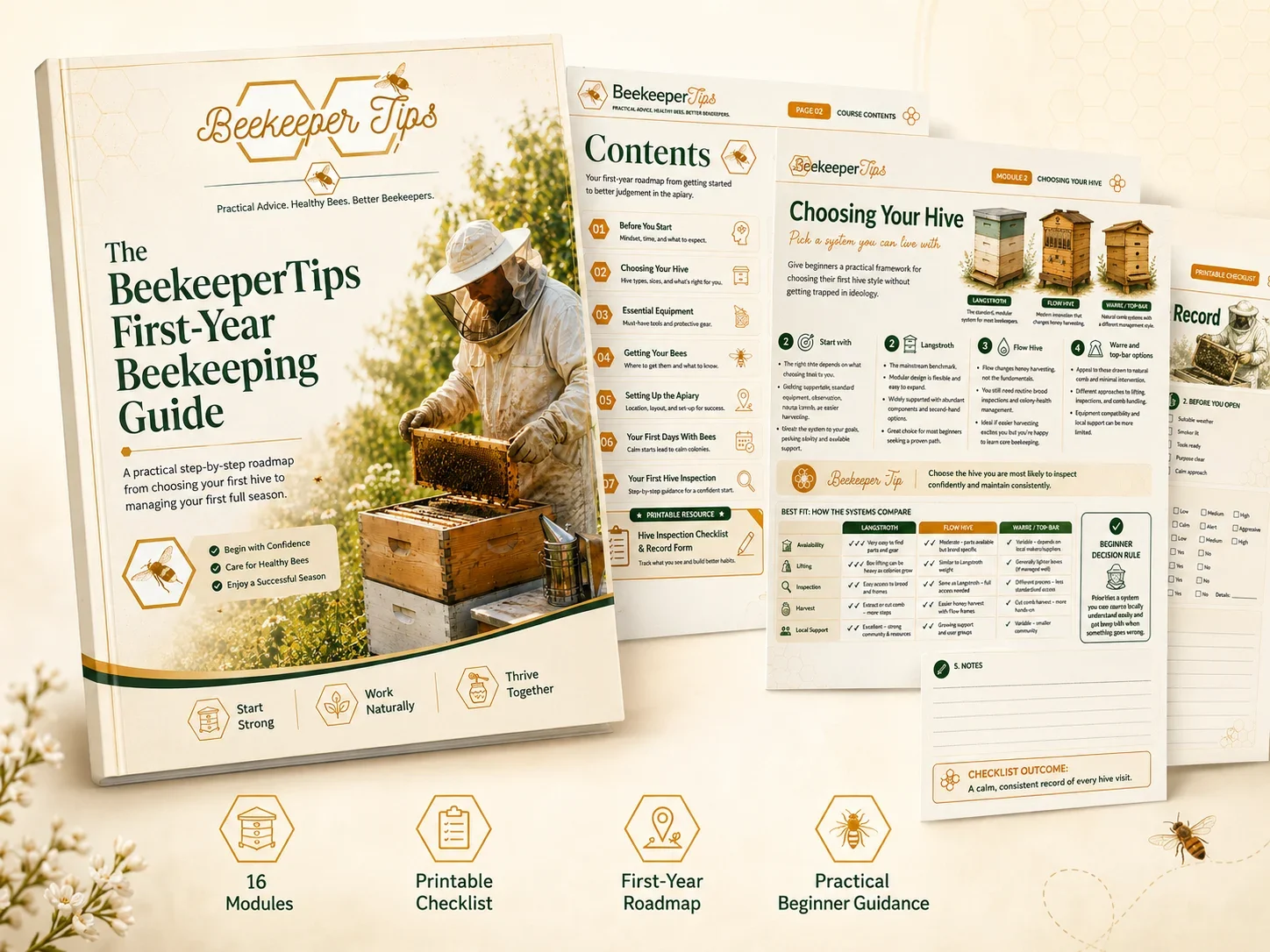
Ready to Start Beekeeping?
Take the next step with our free beginner beekeeping guide. Learn what equipment you need, how to set up your first hive and what to expect during your first season.
You Might Also Like:
 Warre Hive vs Langstroth: Which Is Better for Beginners?
 Best Beehive Types for Beginners: Pros and Cons of 5 Popular Hives
 Is the Flow Hive Worth It? Pros, Cons & What Beginners Should Know
 Expert Mating Nuc Plans: Beekeeping Queen Mating Made Simple
 Buying Honey Bees: Packages vs Nucs for Beginners
 How Much Do Beehives Cost? Ultimate Beginner Budget Guide