
There are no universally “good” or “bad” bees. What matters is whether a colony’s temperament suits the place and the job. A highly defensive colony may cope well in a remote apiary, yet be completely unsuitable beside a suburban fence. Genetics matter, but so do weather, nectar flow, robbing pressure, predators, queen status and how the beekeeper handles the hive.
TL;DR: Judge the colony, not just the label on the bee. African-derived bees can be highly defensive, while Italian, Carniolan and Buckfast lines are often selected for gentleness, but individual colonies vary enormously. If a colony repeatedly attacks before you begin working it, creates a risk to neighbours or remains difficult under otherwise normal conditions, requeening with gentler stock is a practical long-term option.
If you are learning to read colony behaviour, the Beginner Beekeeping guide gives useful background on smoker use, inspections and choosing manageable bees.
Good Bees vs Bad Bees: It Depends on the Job
When we decide that something is good or bad, it is normally a subjective decision. Bees are no different. A colony that suits one beekeeper and one location may be entirely wrong for another.
Let us start with a journey I made to Mbankana in the Democratic Republic of Congo. The journey itself was memorable enough, but what interested me most were the bees. Bees in this part of Africa have a reputation for being extremely defensive.
I remember my first approach to a hive. Everybody else dressed in bee suits, smokers were at the ready and it looked like a military operation. I decided not to put on a bee suit. We gave the entrance and the top of the hive a few sensible toots of smoke and opened it. If you want the mechanism behind that response, see how a bee smoker works.
The bees were more placid than colonies I had worked in Canada, parts of the United States, Slovakia and Japan. These supposedly terrible bees were almost boringly peaceful that day. Conditions matter enormously, which is why knowing when not to open a beehive is as important as knowing how to handle one.
At the next hive, bees covered the box in a layer nearly two inches thick and the colony sounded like an air-conditioning unit on a hot day. We smoked it, opened it, removed honey and closed it again. I did not receive a single sting.
That does not mean the bees were inherently safe. It means colony behaviour is contextual, and knowing how to work with defensive bees makes a very large difference. Where smoke is unsuitable, there are also ways to calm bees without smoke.
Those colonies were also in extraordinary forage. I observed some producing around 200 lb of honey in a year in forest that flowered for much of the year. That is an exceptional local observation, not a normal production benchmark.
Defensive Bees Are Not Necessarily Bad Bees
“Defensive” is a better word than “aggressive” for most honey bee behaviour. Honey bees defend brood, food and the nest entrance against animals they perceive as threats.
Strong defensive behaviour can be useful in wild or remote environments where predators and human interference are real problems. The same behaviour can be unacceptable in a suburban yard.
A bear may learn a painful lesson from a strongly defensive colony. African bees are particularly good at finding the sensitive bits. I will leave the consequences for the bear’s next trip into the bushes to your imagination.
For me, the practical definition is simple: a good colony is one whose temperament matches its location and management purpose.
What Makes a Colony More Defensive?
Genetics are important, but they are not the only factor. Weather, season, nectar dearth, robbing, predators, hive disturbance and beekeeper technique can all change a colony’s response.
Queenlessness or queen problems can also change behaviour, and colonies under stress may become much harder to handle.
A colony that is difficult on one miserable, windy day is not automatically genetically bad. A colony that repeatedly boils out of the entrance, follows people away from the apiary and stings bystanders under ordinary conditions is a different matter.
How I Have Assessed Defensive Behaviour
One crude field comparison I have used is a dark, fuzzy target suspended near the hive entrance. The material attracts defensive bees and gives a quick visual sense of how rapidly a colony responds.
I have used material such as dreadlock braiding extensions, rolled into a small ball and tied to a string. With very defensive African-derived bees, the ball can quickly become covered in bees. With gentler colonies, the response can be dramatically slower.
This is a provocative test, not a toy. Deliberately stimulating a defensive colony can put the beekeeper and anyone nearby at risk, so I would not recommend it as a beginner exercise or in a suburban yard.
Which Honey Bees Tend to Be More Defensive?
There is enormous colony-to-colony variation, so I do not regard a simple league table of subspecies as scientifically reliable. I can, however, describe what I have seen and separate that from the broader biology.
Apis mellifera scutellata and African-Derived Bees
Apis mellifera scutellata, the savannah honey bee of sub-Saharan Africa, is well known for strong colony defence. Bees descended from this subspecies were taken to Brazil in the 1950s and subsequently interbred with European honey bees. Their descendants in the Americas are commonly called Africanized or African-derived honey bees.
It is worth being precise here: “Africanized” does not mean Apis mellifera adansonii. The American population traces primarily to A. m. scutellata ancestry mixed with European honey bee stock.
I have worked very defensive scutellata colonies, but I have also worked colonies from the same broad population that were remarkably gentle. Individual colony variation remains important.
Apis mellifera mellifera
Apis mellifera mellifera can be proper characters. In my experience they can be relatively calm until something annoys them, at which point they can become very determined. They often seem to have a few “face-banger” bees that fly off the frames and make their point personally.
I enjoy these bees, but I treat them with respect. They will educate you if you do not.
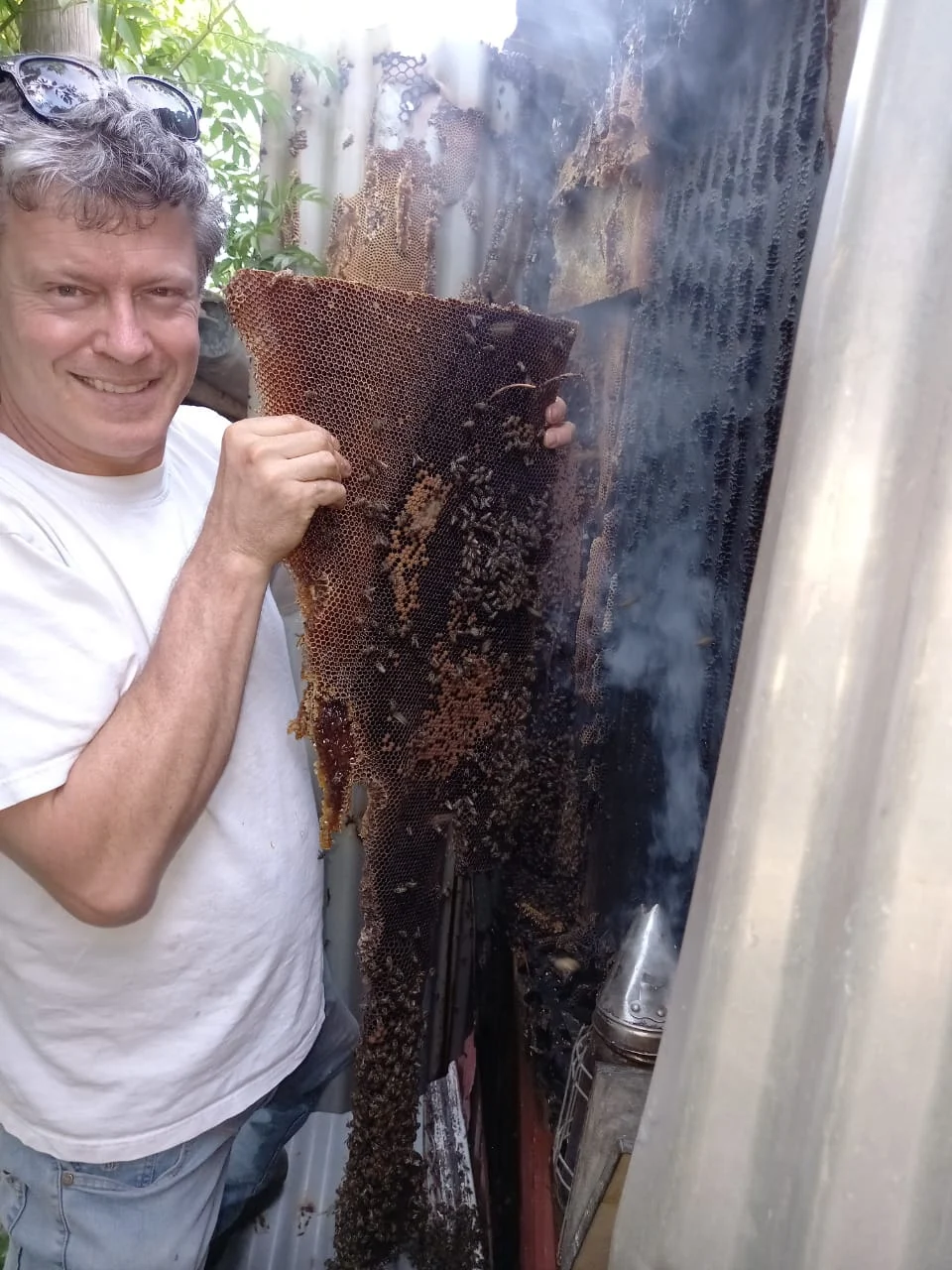
This is me working with Cape honey bees — no bee suit and no stings on that inspection.
Apis mellifera capensis
Apis mellifera capensis, the Cape honey bee, is native to the southern part of South Africa. These are my second favourite bees in the world.
I once found a colony on a cliff while having a picnic in the mountains and managed to take a small piece of honeycomb without a smoker or bee suit. They were remarkably forgiving on that occasion.
Cape bees are biologically unusual for reasons far beyond temperament, particularly because workers can reproduce in ways that allow them to become social parasites in other honey bee colonies. Their generally manageable temperament in many situations should not be confused with harmlessness: any colony can defend itself vigorously when pushed far enough.
To me, Cape bees are the bee that pitches up to play football wearing ice skates. They do not fit neatly into the normal categories.
Apis mellifera carnica
Apis mellifera carnica, the Carniolan bee, is widely bred for manageable temperament. My own experiences have been mixed.
I have been chased out of sunflower and canola fields in Slovakia by colonies identified as carnica before I was even close to the apiary. I have also worked Carniolan-type bees in Canada that were peaceful and easy to handle.
I cannot say exactly what explained that difference. Genetics, pesticide exposure, forage conditions and colony stress were all possible factors. That is precisely why I am cautious about judging a whole subspecies from one apiary.
The Mountain Bees I Have Worked With in Lesotho
I have worked with large, gentle honey bees in the highlands of Lesotho that behaved very differently from many of the lower-altitude African bees I know.
The taxonomy of African mountain honey bee populations has been debated for decades, and I would not assign those colonies confidently to one subspecies from appearance and behaviour alone. There have historically been discussions around mountain-adapted African bees such as Apis mellifera monticola.
What I can say from experience is that the colonies I handled there were exceptionally gentle.
Italian and Buckfast Bees
Apis mellifera ligustica — Italian bees — and many Buckfast bee lines have been deliberately selected for manageable temperament.
I have generally found them forgiving and pleasant to work with. That does not make every Italian or Buckfast colony gentle. Poor breeding, queen changes, robbing, weather and local genetics can all change the result.
Apis mellifera unicolor
Apis mellifera unicolor is the honey bee native to Madagascar. Research also shows genetic relationships between Madagascar populations and honey bees on nearby western Indian Ocean islands.
I have worked colonies of these bees without a bee suit or smoker and, in my experience, they were among the calmest honey bees I have encountered. That remains a personal observation, not a promise that every colony behaves that way.
Are Defensive Bees More Dangerous?
They can be. A colony that recruits many defenders quickly, pursues people for a long distance or attacks bystanders creates a substantially greater public-safety problem than a colony that confines its defence to the immediate hive area.
African-derived colonies can display exactly this type of intense defensive response. Laboratory analysis is needed to reliably confirm African ancestry, so temperament alone should not be used as a genetic diagnosis.
For identification background, see what Africanized bees look like.
Does Defensive Behaviour Mean More Honey?
No. A defensive colony can be productive, but defensiveness itself does not guarantee honey production.
Honey yield depends on colony population, forage, weather, health, queen performance, available comb, swarm control and management. A nasty colony in poor forage can make very little surplus honey, while a gentle colony in a strong nectar flow can fill supers rapidly.
What Makes a Good Colony for Backyard Beekeeping?
For me, a colony kept in town must be manageable. If I cannot inspect it without creating a hazard for neighbours, pets or people walking nearby, its temperament is wrong for that location.
A good backyard colony should allow normal inspections with sensible smoke and calm handling. Occasional defensive days are normal. Persistent attacks are not something I would simply accept.
In a remote apiary, I may tolerate considerably more defensive behaviour. The risk profile is different.
What to Do With a Persistently Defensive Colony
Before blaming genetics, check the obvious things: weather, robbing, nectar dearth, predators, queen status, excessive disturbance and whether your smoker technique is making the problem worse rather than better.
If the colony remains dangerously defensive, requeening with a queen from stock selected for gentleness is a standard long-term management option.
The change is not immediate. Worker bees take about three weeks to develop from egg to emergence, and the old queen’s adult daughters remain in the colony after the new queen begins laying. It can take several additional weeks before the workforce most inclined to defend the hive has been substantially replaced.
Where neighbours or livestock are at risk, move or isolate the colony appropriately while that transition occurs rather than assuming a newly introduced queen instantly solves the problem.
The Bottom Line on Good Bees vs Bad Bees
Good bees for one job may be bad bees for another. The important question is not whether a subspecies has a reputation for being gentle or fierce; it is whether the individual colony can be managed safely and productively where you keep it.
I like bees with character. In a remote apiary I am happy for them to be capable of defending themselves. In my garden, I want bees that I can work without turning the neighbourhood into a war zone.
And in the broadest sense, all these bees are doing the same remarkable job: maintaining a colony, gathering food and pollinating flowers. The trick for the beekeeper is choosing the right temperament for the place.
Defensive Honey Bee FAQs
What makes a honey bee colony defensive?
Colony defensiveness is influenced by genetics, season, weather, nectar dearth, robbing pressure, predators, disturbance, queen status and how the hive is handled. A colony that is calm at one time can be much more defensive under different conditions.
Are Africanized honey bees the same as African honey bees?
Not exactly. Africanized honey bees in the Americas are descended largely from Apis mellifera scutellata that interbred with European honey bees. The term African honey bee is broader and can refer to African subspecies in their native range.
Are defensive bees always bad bees?
No. Strong defensive behaviour can help a colony protect itself, but it is undesirable where people, pets or livestock are close to the apiary. The right temperament depends heavily on where the colony is kept.
Can requeening make an aggressive colony gentler?
Yes, if genetics are an important cause. Requeening with stock selected for gentleness can reduce defensiveness as the new queen’s daughters replace the old workforce, but this takes several weeks rather than happening immediately.
How long does it take for requeening to change colony temperament?
Expect several weeks. Worker development takes about three weeks from egg to emergence, and older defensive workers remain in the colony until they are gradually replaced by daughters of the new queen.
Are Italian and Buckfast bees always gentle?
No. Italian and many Buckfast lines are often selected for manageable temperament, but any colony can become defensive because of genetics, poor conditions, queen problems, disturbance or local environmental pressures.
Does a more defensive colony make more honey?
Not necessarily. Honey production depends on colony strength, forage, weather, health, swarm control and management. Defensive behaviour by itself does not guarantee higher honey yield.
Should beginner beekeepers keep highly defensive colonies?
Usually not, especially in suburban settings. Beginners are better served by manageable stock while they learn hive handling, smoke use and colony behaviour. Persistently dangerous colonies should be moved, requeened or otherwise managed by an experienced beekeeper.

Dr Garth A. Cambray is a beekeeper, biotechnologist and researcher with nearly three decades of practical beekeeping experience. He holds a PhD in Biotechnology from Rhodes University and has worked extensively in honey production, fermentation biotechnology and value-added bee products. View Dr. Garth Cambray’s credentials, research and experience.

Ready to Start Beekeeping?
Take the next step with our free beginner beekeeping guide. Learn what equipment you need, how to set up your first hive and what to expect during your first season.
You Might Also Like:
 Bees, Your Neighbours and the Law: Can You Keep Bees in Your Backyard?
 How Long Can a Hive Be Queenless?
 How Many Beehives Can One Person Manage? A Practical Guide
 What Do African Bees Look Like? Africanized Honey Bees Explained
 Chalkbrood Treatment: How to Manage and Prevent It
 Bees Left Behind After a Swarm